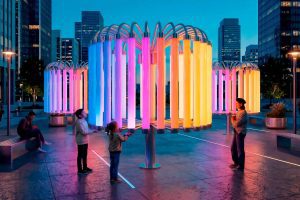
Public Art as Wayfinding in Large Public Spaces
In large public environments, orientation is rarely achieved through signage alone. Airports, cultural districts, commercial centers, waterfronts, transport interchanges, museum campuses, and mixed-use developments all depend on more complex systems of spatial legibility. Visitors read these environments through movement, sequence, visibility, memory, and association long before they stop to process a map or a directional sign. This is where public art takes on a role that is often underestimated in design discussions: it becomes part of the wayfinding structure of the place itself.
For architects, urban planners, and developers, the value of public art in large public spaces is not limited to identity or visual interest. Sculptural and kinetic installations can help organize movement, reinforce hierarchy, distinguish zones, and create memorable points of reference within otherwise complex environments. In the strongest projects, public art functions less as an isolated object and more as spatial infrastructure embedded into the logic of circulation and perception.
This is particularly relevant in contemporary public environments, where users are expected to navigate layered programs and multiple thresholds with minimal friction. A visitor may move from parking to plaza, from retail podium to office lobby, from concourse to gate, or from museum forecourt to interior atrium in a matter of minutes. In such settings, clarity depends not only on information systems, but on how the space is composed. Public art can sharpen that composition in ways that conventional wayfinding devices cannot.

Why wayfinding in large public spaces is an architectural problem
Wayfinding is often treated as a graphic problem, as though orientation begins once signs are added to an already completed environment. In reality, orientation is established much earlier. It begins with spatial hierarchy, with the distinction between primary and secondary routes, with the visibility of entrances, with the structure of plazas and thresholds, and with the presence of strong reference points within the public realm.
Large public spaces become difficult to navigate when they lack hierarchy. The issue is not always scale itself. More often, the problem is repetition. Long retail frontages, oversized concourses, visually neutral plazas, and multi-level atria without clear anchors can all produce the same result: users move through them without building a stable mental map.
In this sense, wayfinding is inseparable from architecture and urban design. People do not navigate by reading a space as an abstract plan. They orient themselves through memorable elements, repeated visual cues, and fixed points of recognition. They remember where they entered, what they saw from a distance, what marked the center, and which object signaled the turn toward the next destination. Public art becomes powerful in exactly this context. It gives physical form to memory inside the built environment.
For clients, this has direct implications. If a project depends on intuitive movement through a large public environment, then orientation cannot be treated as a layer to solve at the end. By the time the team is relying only on signage to create clarity, the deeper spatial logic is often already fixed.

How public art creates spatial legibility
A successful public art installation can clarify a space in three ways at once. First, it can establish a visible anchor within a larger field. Second, it can distinguish one zone from another without relying on barriers. Third, it can reinforce a sequence of movement by drawing attention toward key transitions.
This matters most in open public environments where enclosure is limited and directional clarity depends on visual structure rather than walls. A plaza, for example, may serve as the social and circulatory center of a development, yet still feel ambiguous if nothing defines its primary orientation. A sculpture placed in the right position can terminate an axis, consolidate a gathering point, or signal the center of the site. It gives the user an immediate answer to an otherwise subtle question: where is the middle, and where do I move next?
The effectiveness of this role depends on placement more than symbolism. Public art supports orientation when it aligns with the logic of movement. It must be visible from meaningful approach routes, scaled to its urban field, and positioned in relation to how people actually enter and cross the space. A sculpture hidden within landscaping may still be beautiful, but it will not function as a navigational device. Likewise, an oversized object placed without regard to circulation can dominate the visual field while making the space less usable.
What matters is not only the artwork itself, but the relationship between the artwork and the surrounding architectural frame. Paving geometry, canopy lines, stair locations, retail frontages, façade rhythm, and lighting conditions all influence whether an installation clarifies the environment or competes with it. When these elements are coordinated, the artwork becomes part of a coherent spatial syntax.
Orientation through landmarks rather than instructions
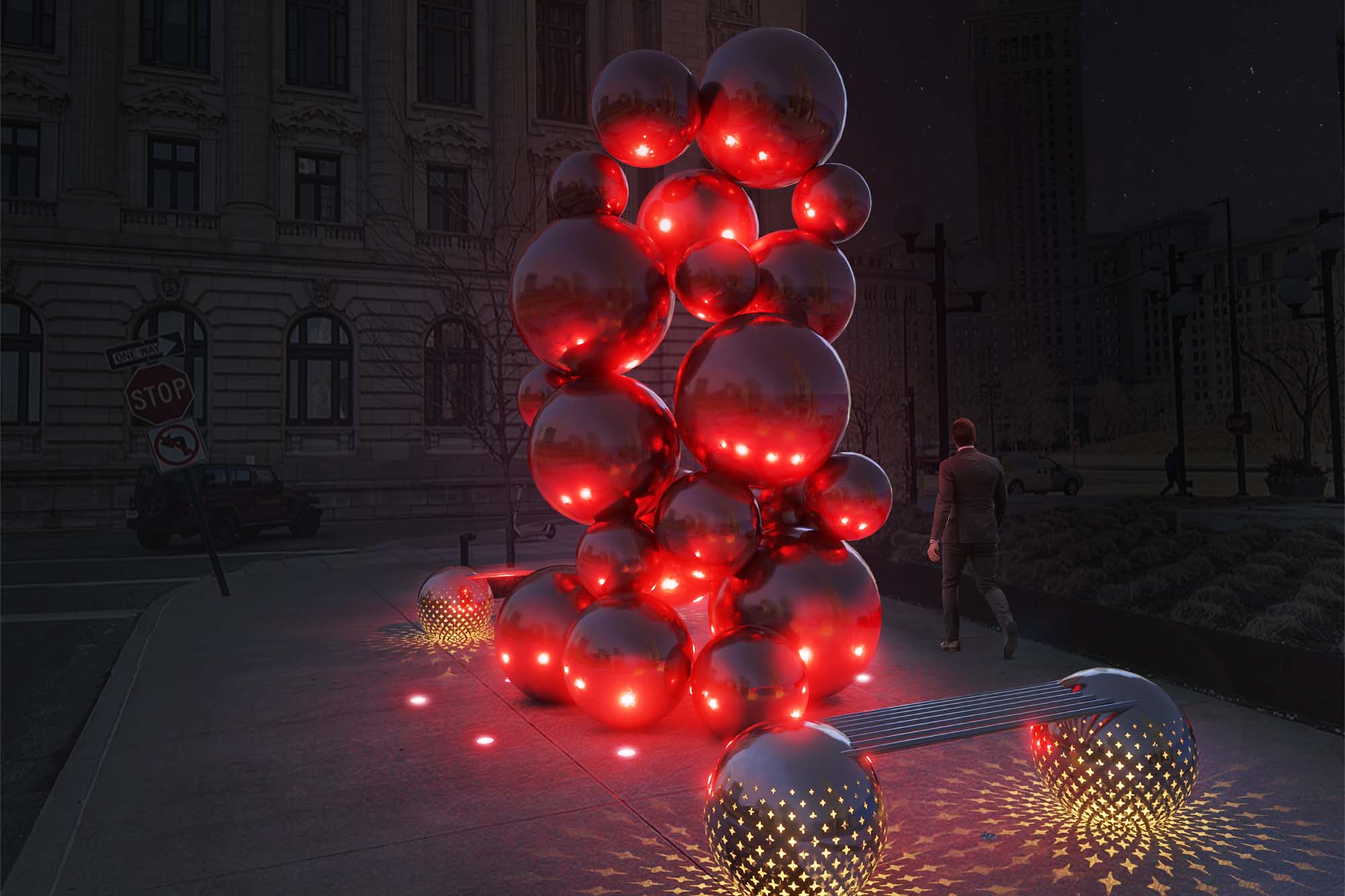
People trust landmarks more than instructions. In unfamiliar environments, they instinctively rely on recognizable features rather than on abstract directional systems. This is why in large public spaces users often say they will meet near the fountain, by the suspended sculpture, beside the illuminated installation, or under the red structure in the plaza. These are not informal alternatives to wayfinding. They are the wayfinding system as people actually use it.
Kevin Lynch’s idea of urban legibility remains relevant here, even in contemporary commercial and institutional environments. People understand space through nodes, paths, edges, districts, and landmarks. Public art has the unusual ability to operate across several of these categories at once. It can define a node, reinforce a path, articulate an edge, distinguish a district, and become the landmark that ties the whole sequence together.
This is why landmark installations often outperform signage in terms of memory. A sign may tell a visitor where to go once, but a strong landmark allows the visitor to remember the route later without assistance. That difference matters in environments that depend on repeat use. Airports, university campuses, business districts, museum precincts, and mixed-use developments all benefit when visitors can build intuitive familiarity over time rather than repeatedly relying on instructions.
Cloud Gate in Chicago is a useful example. While it is typically discussed as a tourist icon, it also functions as an orientation anchor within Millennium Park. It gives visitors a stable point of reference within a large, open public environment that includes lawns, pavilions, pathways, and event spaces. Its value is not only symbolic. It helps structure how people understand where they are within the park.
Public art in airports, campuses, and transport environments
The wayfinding role of public art becomes particularly clear in airports and transport hubs, where large volumes of people move through layered programs under time pressure. These spaces are shaped by thresholds, waiting zones, security sequences, vertical transitions, and distributed destinations. Conventional signage remains essential, but it is not sufficient on its own to make the environment feel navigable.
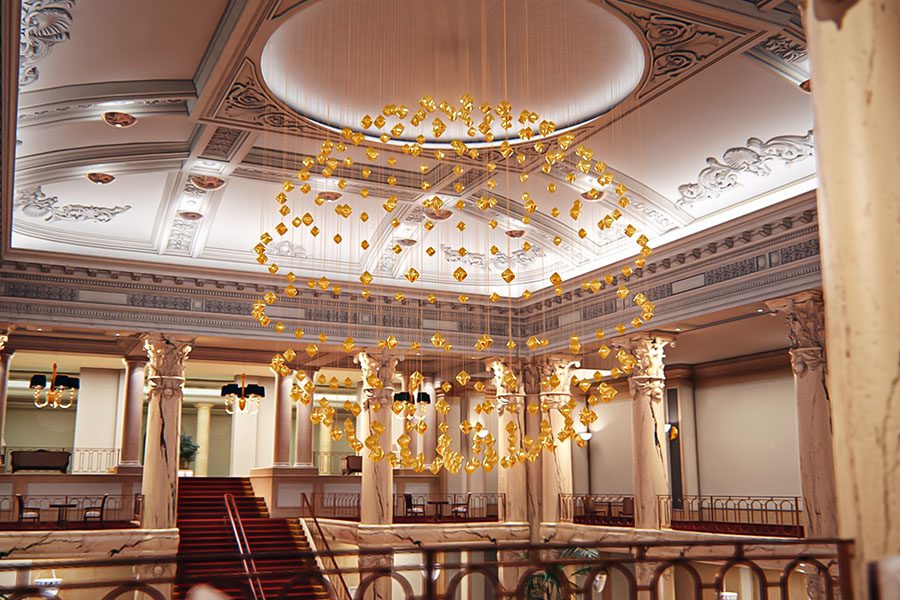
In airports, suspended installations in atria, sculptural elements near major decision points, and light-based interventions along passenger flows can all reinforce the legibility of the terminal. They help distinguish central circulation zones from dwell spaces and make major nodes easier to identify from a distance. A well-placed artwork in a terminal concourse can do more than enrich the passenger experience. It can reduce ambiguity in a large-scale movement environment.
Denver International Airport has long understood the role of public art in shaping passenger perception, even when individual works have generated debate. Changi Airport in Singapore offers another model, where art, landscape, and architectural composition contribute to a sense of orientation that extends beyond signage. These examples differ in style and cultural context, but they share one principle: art is used to shape the way a terminal is read spatially.
The same applies to university campuses and cultural precincts. In these environments, visitors often move through a combination of exterior routes, courtyards, atria, and public lobbies without a continuous enclosed circulation system. Public art helps tie these sequences together. A sculpture at a campus crossroads, for example, can identify a central meeting node while reinforcing the importance of a route between academic and social spaces. In museum campuses, installations often distinguish forecourts and thresholds where architecture alone may not clearly signal public entry.
For project teams working on these environments, this is exactly why art should be discussed during planning rather than after spatial decisions are already made. Once primary routes, sightlines, and nodal relationships are fixed, the ability of an installation to improve orientation becomes much more limited.
Spatial hierarchy in commercial and mixed-use developments
In commercial districts and mixed-use projects, public art supports wayfinding not because users are lost in a literal sense, but because these environments succeed when movement feels intuitive and socially attractive. A mixed-use development can contain residential towers, retail streets, office lobbies, dining terraces, event zones, structured parking, and transit connections within a single site. Without a strong hierarchy, these environments become hard to read, particularly for first-time visitors.
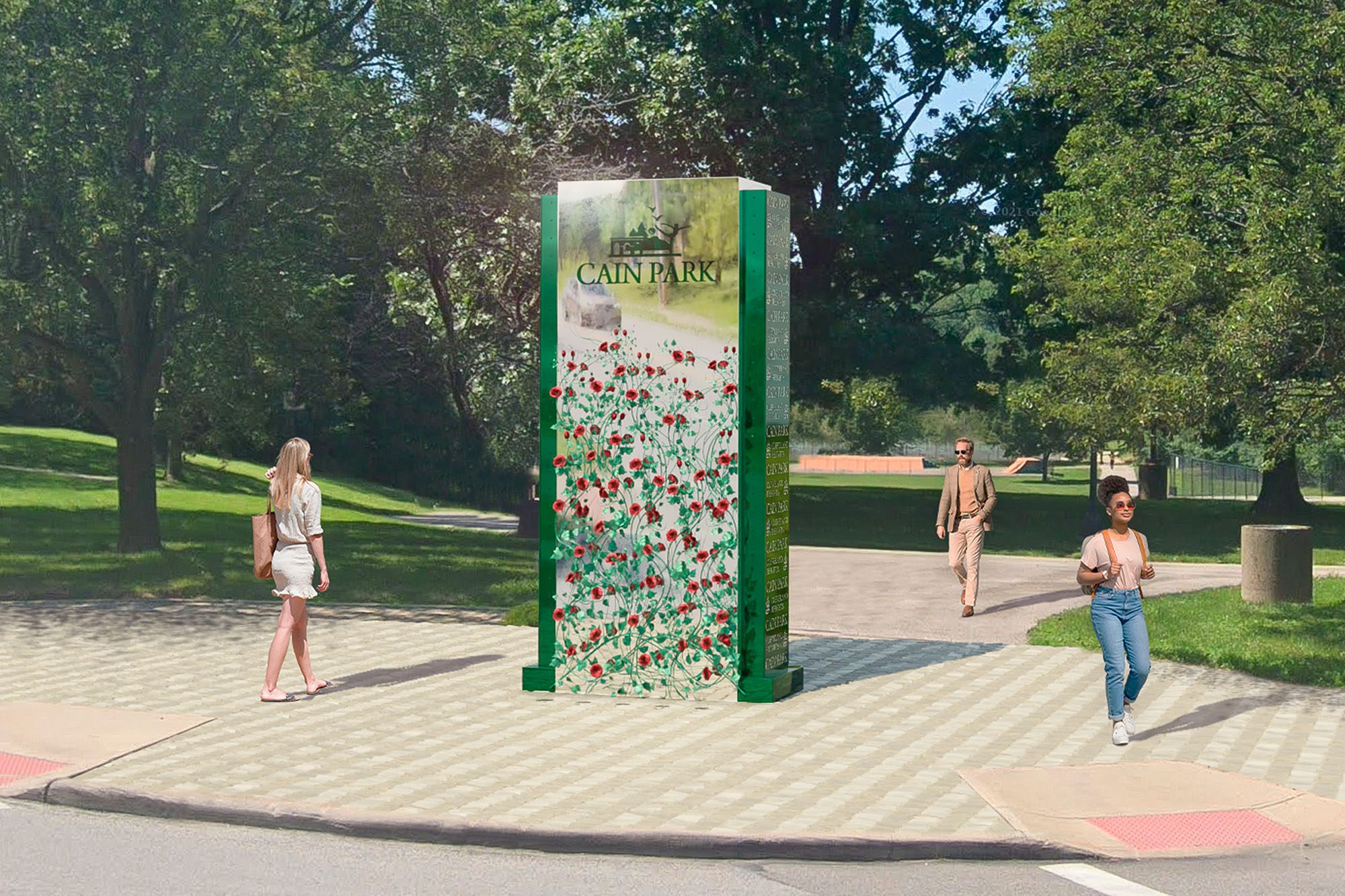
Public art can solve this by marking primary public space, signaling entry conditions, and differentiating one character zone from another. A central plaza installation may establish the social core of the project. A linear artwork can reinforce a pedestrian spine. A suspended element in a retail atrium can define the vertical center of a multi-level environment. Even smaller sculptural interventions can help identify transitions between commercial and residential zones.
This is one reason high-performing developments increasingly integrate art during masterplanning rather than after completion. When the installation is coordinated with circulation and spatial sequence from the beginning, it can strengthen the project’s internal logic. When it is inserted at the end as a branding gesture, it often becomes an object without navigational function.
At DION ART STUDIO, this intersection between public art, architecture, and movement is where the work becomes most meaningful. In large developments, the question is rarely just what the installation should look like. The more consequential question is what role it should play in how the environment is understood, entered, crossed, and remembered.



Kinetic and interactive installations as dynamic orientation devices
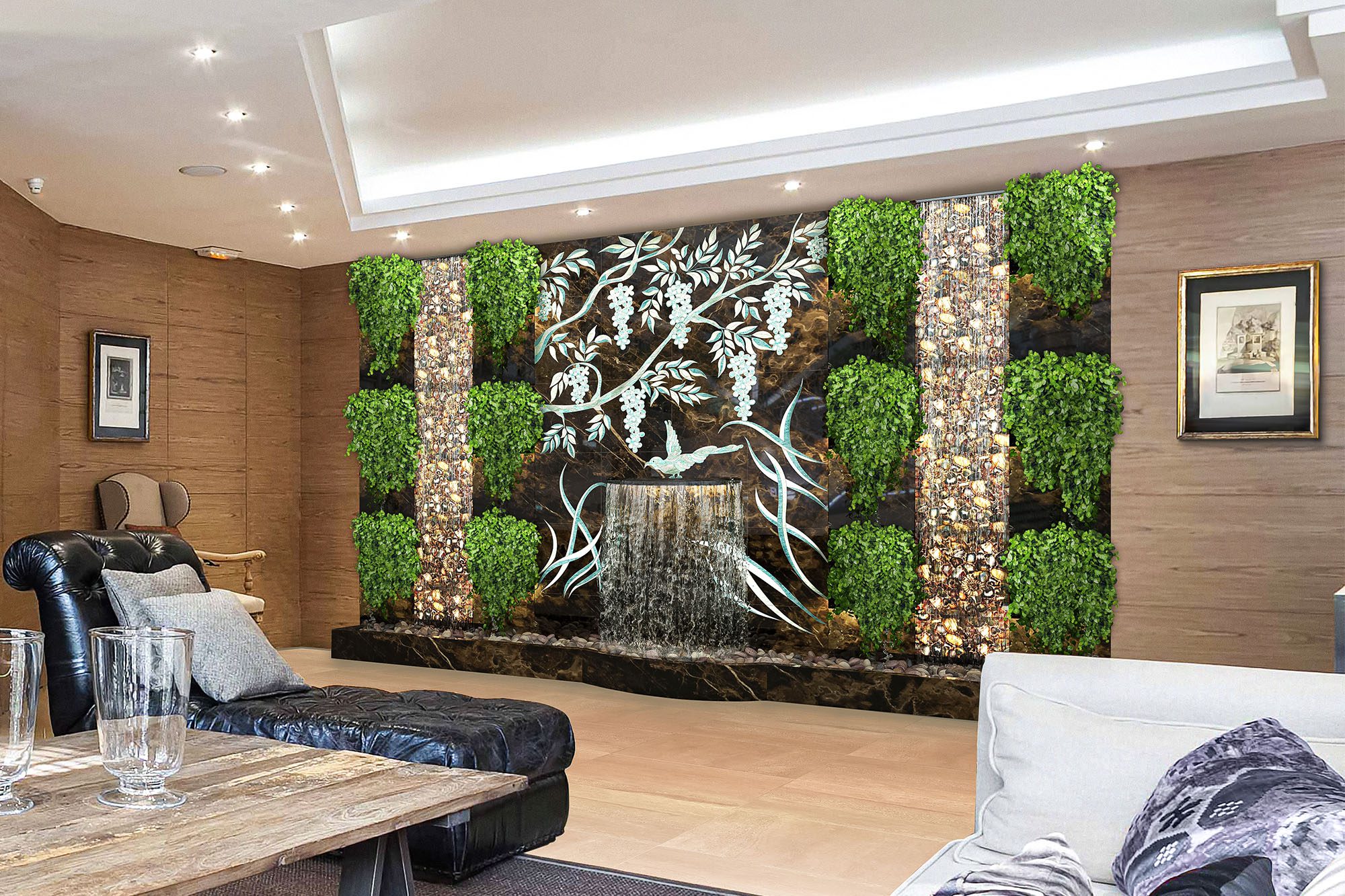
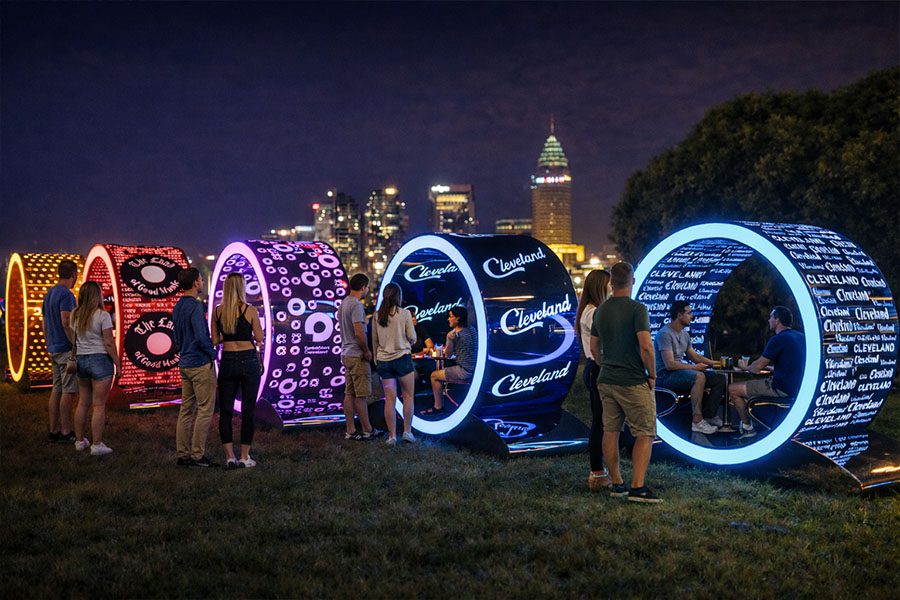
Kinetic and interactive installations introduce another layer to wayfinding because they operate in time as well as space. Movement, light change, and responsiveness can make an element more noticeable, more memorable, and more effective as a point of reference. In large public environments, this can be extremely valuable. A dynamic object attracts attention differently from a static one, especially in visually dense contexts where many surfaces compete for focus.
This does not mean every wayfinding-oriented artwork should be kinetic. In some contexts, movement may create distraction rather than clarity. But when designed with discipline, kinetic installations can reinforce hierarchy by drawing attention to major nodes or signaling the importance of particular thresholds. In transport hubs, this may mean marking a central atrium or a transition between public and controlled zones. In commercial spaces, it may mean reinforcing the identity of a gathering point that users return to repeatedly.
Interactive installations can also support orientation by turning recognition into participation. When users remember an environment through responsive artwork, they build a stronger mental association with that location. The installation becomes not only something seen, but something experienced. This can be especially powerful in museum foyers, civic interiors, and mixed-use destinations where repeat engagement matters.
The challenge is restraint. If movement or interactivity is too complex, too dispersed, or too detached from the broader spatial order, the installation may become spectacle without wayfinding value. The most effective dynamic artworks are not those that demand constant attention. They are those that strengthen the larger readability of the place.
When public art weakens wayfinding instead of helping it
Public art does not automatically improve orientation. In some projects, it does the opposite. This usually happens for one of three reasons. The first is poor placement. An installation may occupy a central position without corresponding to actual movement patterns, which means it interrupts circulation rather than organizes it. The second is an incorrect scale. Works that are too small disappear within large urban fields, while oversized objects can crowd plazas and reduce spatial clarity. The third is visual competition. If an installation competes with primary entrances, retail signage, or architectural focal points, it can create confusion instead of hierarchy.
This is why public art should be evaluated not only as an object but as part of a compositional system. Designers need to consider approach speeds, sightlines, viewing distances, daylight conditions, nighttime visibility, maintenance routes, and how the artwork relates to the public use of the site. A piece that looks compelling in isolation may underperform when confronted with the real complexity of a large public environment.
There is also a common development mistake here. Teams sometimes hope that adding a landmark late in the process will correct an already ambiguous public realm. In practice, this rarely works. If the circulation logic is weak, entrances are visually unresolved, or central nodes are poorly defined, a sculpture introduced after the fact usually becomes another object to navigate around rather than a device that improves clarity. Art can strengthen a strong spatial structure. It is much less effective at rescuing a weak one.
Art as infrastructure for public understanding
The most sophisticated use of public art in large public spaces is not symbolic but operational. It helps people understand where they are, where they are going, and what part of the environment matters most. In this sense, art becomes a form of public infrastructure, not because it replaces architecture or signage, but because it reinforces both.
This is particularly relevant in contemporary projects that want to feel open, fluid, and less overtly controlled. Many large public environments today are intentionally informal in character. They avoid rigid spatial boundaries in favor of flexible public zones. But openness without legibility creates uncertainty. Public art helps restore structure without resorting to hard separation. It can create hierarchy while preserving generosity.
For architects and planners, this makes art a useful tool in environments where experience and orientation must coexist. The same installation can contribute to place identity, social use, and navigation at once. That layered performance is precisely why public art deserves to be considered earlier and more strategically in the design of large public spaces.
For developers and design teams, the practical implication is clear. If a project relies on intuitive movement through a large public environment, art should not be commissioned only as a visual addition. It should be planned as part of the spatial strategy of the site.
Public art plays a far more serious role in large public spaces than visual enhancement alone. In airports, campuses, mixed-use developments, museum precincts, and civic plazas, it can help structure how environments are read, remembered, and navigated. It reinforces spatial hierarchy, clarifies nodes, supports intuitive movement, and gives users stable reference points within complex public systems.
The strongest installations do not merely occupy plazas or animate atria. They participate in the wayfinding logic of the project. They help turn large environments into legible ones and open public fields into places people can understand.
As public spaces become larger, more hybrid, and more experience-driven, this role will only grow in importance. Wayfinding is not only about telling people where to go. It is about shaping environments that make sense before instructions are needed. Public art, when integrated with architectural and urban strategy, is one of the most powerful tools available for doing exactly that.
This is also why the timing of the conversation matters. The greatest value rarely comes from selecting an artwork after circulation, hierarchy, and public-space logic are already fixed. It comes from considering art early enough for it to participate in the spatial intelligence of the project itself.


Contact Us
In large public environments, wayfinding problems are rarely solved by objects added late in the process. They are solved through spatial clarity, coordinated placement, and a precise understanding of how people move, pause, gather, and remember space.
At DION ART STUDIO, we work with architects, developers, and planners to create kinetic and public art installations that do more than enrich the visual character of a project. We help shape artworks as part of the architectural and urban logic of the site — with attention to visibility, hierarchy, circulation, integration, and long-term performance.
If you are planning a mixed-use development, airport, campus, cultural destination, or large public space where intuitive movement matters, the most effective moment to discuss public art is during the design phase, not after the wayfinding challenges are already built into the environment. Our team can help explore how an installation may contribute to orientation, public experience, and the larger identity of the project.
Public art helps by creating visible landmarks, clarifying key nodes, reinforcing spatial hierarchy, and giving visitors memorable reference points they can use to navigate intuitively.
It is especially effective in airports, mixed-use developments, university campuses, museum precincts, public plazas, and large commercial environments where users move through layered and complex spaces.
It serves a different function. Signage provides explicit information, while public art supports memory, recognition, and spatial understanding. The strongest projects use both together.
Yes, when used carefully. Kinetic and interactive installations can make key nodes more visible and memorable, but they need to support spatial clarity rather than distract from it.
Ideally during masterplanning or early design coordination, when placement, sightlines, circulation, infrastructure, and spatial hierarchy can still be shaped together.
Written by

Сo-founder & Creative director of DION ART
Master of Arts in Art Education, Public Art (School of the Art Institute of Chicago, USA)
Share this post