Art installations for shopping malls and commercial centers
The contemporary shopping mall is no longer designed as a purely commercial structure. Over the past two decades, retail architecture has evolved into a hybrid typology that merges commerce, leisure, culture and public space. As a result, developers increasingly treat commercial centers not simply as buildings but as urban destinations with their own identity and spatial character.
Within this shift, art installations shopping malls have become an important architectural strategy. Sculptural installations, kinetic artworks and large-scale atrium elements are frequently integrated into commercial interiors to shape spatial perception and establish recognizable landmarks inside complex environments.
In large retail environments—often exceeding hundreds of thousands of square meters—architecture alone does not always provide sufficient orientation or visual hierarchy. Carefully positioned commercial center art installation elements can structure space, anchor circulation routes and introduce memorable visual moments that transform anonymous interiors into places with character.
For contemporary retail architecture, art is increasingly understood not as decoration but as part of spatial composition.

Sculptural anchors in large retail environments
Shopping malls are among the most complex public interiors in contemporary architecture. Multiple levels, long circulation corridors and vast atrium spaces can easily feel disorienting without strong visual reference points.
This is where mall sculpture design plays a crucial role. Sculptural installations placed within central atriums, intersections of circulation paths or major gathering areas help establish spatial hierarchy and visual anchors inside the building.
Visitors instinctively navigate through recognizable objects. In large retail complexes, a shopping mall landmark sculpture often becomes the reference point around which the entire spatial experience is organized. From upper balconies, escalators and bridges, the sculpture remains visible, allowing visitors to maintain orientation while moving through different levels of the building.
Architecturally, these installations also help stabilize the scale of large interior volumes. Atriums in modern commercial centers can reach heights of 20–40 meters. A carefully proportioned sculpture occupying part of that vertical space helps balance the architectural composition and introduces a human scale into otherwise monumental interiors.
In this sense, sculpture becomes a spatial device rather than a decorative element.
Atrium installations and vertical spatial composition
The atrium is often the most dramatic architectural element of a shopping mall. These large vertical voids connect multiple floors, visually linking retail levels, entertainment areas and food courts.
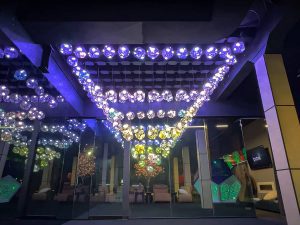
Because of their scale, atriums present unique opportunities for large atrium kinetic sculpture installations. Suspended artworks introduce movement and rhythm into the vertical space, transforming an empty void into a dynamic spatial experience.
Kinetic installations are particularly effective in retail environments because they subtly activate the atmosphere of the building. Slow, continuous movement draws attention upward and encourages visitors to engage with the full height of the space.
A mall atrium sculpture also influences how people perceive the architecture itself. Instead of simply passing through a large open volume, visitors experience the atrium as a curated environment where architecture and art work together.
Projects developed by DION ART STUDIO explore this relationship between movement, scale and architecture. By combining sculptural form with engineering systems and digital technologies, the studio creates installations that transform large atriums into dynamic visual landmarks within commercial environments.
Art installations as retail attractions
Beyond spatial composition, art installations also influence how visitors interact with retail environments. Physical retail spaces increasingly compete with digital commerce, making experience and atmosphere essential components of successful developments.
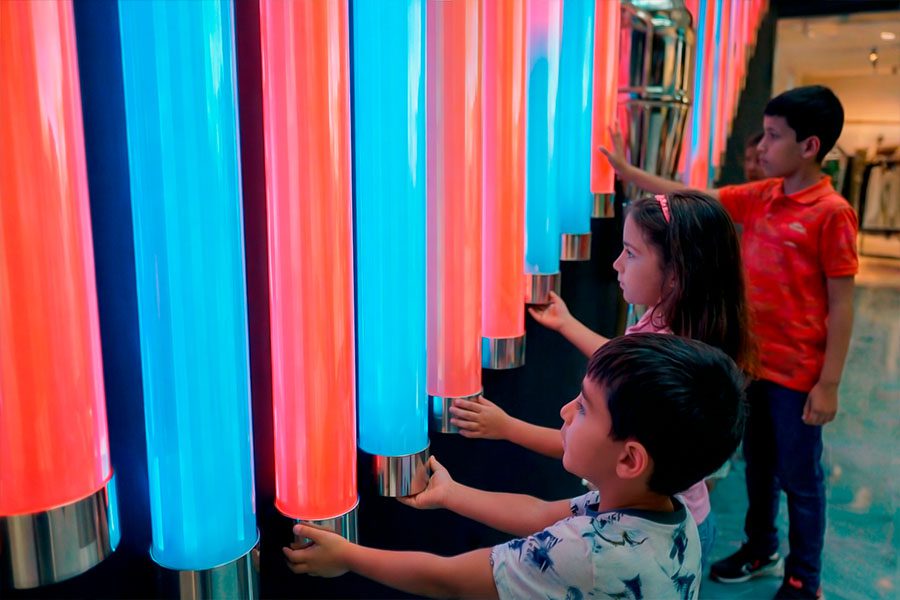
A well-designed retail attraction installation can become a destination within the shopping mall itself. Visitors pause beneath large sculptures, photograph kinetic ceilings or gather around interactive art. These moments extend the time people spend inside the building and encourage exploration beyond the primary shopping areas.
Interactive works take this engagement even further. An interactive retail installation may respond to movement, light or proximity, subtly changing its behavior as visitors pass through the space. These responsive environments create moments of discovery that transform circulation areas into experiential zones.
From a spatial perspective, such installations also slow down movement within high-traffic areas. Instead of simply moving between stores, visitors engage with the environment, creating more vibrant public spaces inside the commercial center.

Integration with commercial master plans
The most effective retail art installations are integrated into the architectural concept from the earliest design stages. When artwork is considered during the masterplanning process, it can influence circulation routes, sightlines and spatial sequences throughout the building.
In large mixed-use developments, sculptures often mark key nodes within the spatial structure—entrances, atriums, plazas or intersections between different functional zones. A commercial architecture art installation can therefore serve as a transition point between retail streets, leisure zones and entertainment areas.
This integration also affects how the development is perceived from outside. Sculptural elements visible through glass façades or positioned in exterior plazas establish a visual connection between interior and exterior spaces.
The result is a more cohesive architectural narrative where art, landscape and architecture contribute equally to the spatial identity of the development.
At DION ART STUDIO, this collaborative approach is central to the design process. Installations are often conceived in dialogue with architects and developers, ensuring that sculptural works respond to the scale, geometry and circulation patterns of the building.

Landmark art in major shopping malls
Many contemporary retail developments already demonstrate how large-scale art can structure spatial experience and become an architectural signature of the building.
One of the most widely recognized examples is the monumental KAWS Companion sculpture at Harbour City in Hong Kong. Installed in the open plaza connected to the shopping complex, the sculpture transformed the commercial waterfront into a cultural landmark. Visitors gathered around the installation, turning the retail district into a public destination rather than simply a shopping area.
Another notable example is the Whale sculpture suspended inside Dubai Mall, designed by artist Frank Gehry and constructed from thousands of aluminum elements. Positioned within the mall’s central atrium, the sculpture occupies a large vertical volume and remains visible from multiple floors. It functions as both a landmark and a spatial anchor within one of the largest retail environments in the world.
In London, Westfield Stratford City has integrated several public artworks into its retail landscape, including large sculptural elements within plazas and entrances that connect the mall to the surrounding Olympic Park district. These works extend the identity of the development beyond its commercial program and into the broader urban context.
In Singapore, Jewel Changi Airport, which combines retail, gardens and public attractions, demonstrates another approach. While not a traditional shopping mall, the complex integrates the famous Rain Vortex installation within a multi-level retail environment. The installation organizes the spatial hierarchy of the entire building, guiding circulation around a central vertical landmark.
These examples illustrate how retail art installations can operate at the scale of architecture itself, structuring circulation, shaping perception and turning commercial environments into memorable destinations.
Identity and branding through landmark installations
Large shopping centers increasingly function as urban landmarks within their cities. In this context, sculptural installations contribute not only to spatial quality but also to the identity and branding of the development.
A distinctive shopping mall landmark sculpture often becomes the most recognizable element of the building. Visitors remember the installation long after leaving the space, and images of the artwork frequently circulate in media, promotional material and social platforms.
For developers, this relationship between art and identity is particularly valuable. A strong public art retail installation can give a commercial center a unique visual signature, distinguishing it from other retail destinations within the city.
Architecturally, these landmarks also help anchor large public interiors within the broader urban context. Just as towers or plazas define city skylines, interior sculptural installations can define the spatial identity of major commercial environments.

Visitor experience and spatial perception
Ultimately, the success of art installations in retail architecture lies in how they influence visitor perception. Large commercial interiors are complex spatial systems where movement, visibility and orientation constantly interact.
Sculptural installations shape this experience by introducing strong visual cues. Visitors frequently use large artworks as meeting points, navigational markers or reference objects when describing locations within the building.
In multi-level environments, sculptures visible across several floors create visual continuity between spaces. They guide movement vertically and horizontally, subtly influencing how people explore the building.
Within the broader context of contemporary retail architecture, art installations shopping malls therefore operate as spatial infrastructure. They organize perception, structure movement and give large commercial environments a memorable character.
As shopping malls evolve into hybrid urban destinations, the integration of art into commercial architecture is becoming increasingly significant. Sculptural installations, kinetic artworks and large atrium elements now play an important role in shaping the spatial identity of retail environments.
Rather than functioning as decorative additions, these installations structure perception, guide movement and reinforce the architectural hierarchy of large commercial interiors. When integrated thoughtfully into the design of a project, they transform shopping malls into places with strong visual identity and meaningful public spaces.
Contact Us
Ready to create a distinctive art installation for your shopping mall or commercial center? Explore our concepts or contact the DION ART STUDIO team to discuss your project.
In contemporary retail architecture, art is no longer an accessory but a spatial tool that shapes how visitors experience commercial environments. Sculptural and kinetic installations introduce identity, structure large interiors, and transform anonymous malls into recognizable destinations. In a landscape where physical retail competes with digital commerce, memorable spatial experiences become a key differentiator.
A well-designed installation can act as the focal point of an atrium, a navigational anchor across multiple levels, or a visual signature of the entire development. Through movement, light, and scale, these works create environments that visitors remember, return to, and share.
At DION ART STUDIO, we design and engineer large-scale art installations for shopping malls, mixed-use developments, and public interiors. Our projects combine sculptural form, kinetic systems, and advanced technologies to create landmark elements that define contemporary commercial spaces.
Written by

Сo-founder & Creative director of DION ART
Master of Arts in Art Education, Public Art (School of the Art Institute of Chicago, USA)
Share this post