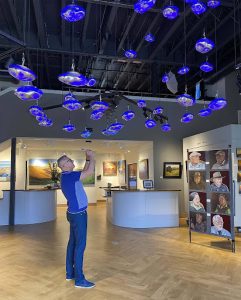
Kinetic Sculptures for Office Buildings and Corporate Campuses
In the United States, workplace environments are no longer evaluated only through efficiency, floorplate performance, or façade quality. Office buildings and corporate campuses are increasingly expected to operate as identity-driven environments that shape first impressions, support tenant positioning, and make the daily experience of the workplace more memorable. In premium commercial real estate, this shift is especially visible in Class A office developments, repositioned headquarters, innovation campuses, and mixed-use office districts competing for tenants, talent, and long-term relevance.
Within this context, kinetic sculpture has become more than a decorative gesture in a lobby or plaza. It can function as part of the architectural and experiential logic of the workplace itself. In the strongest projects, it sharpens arrival, gives hierarchy to large interior volumes, strengthens campus-scale identity, and introduces movement into environments that might otherwise feel visually static or spatially generic.
For developers, architects, and corporate clients, the value of kinetic sculpture lies not simply in visual distinction. Its importance comes from the way it can influence perception, shape public-facing identity, and structure the way a workplace is entered, remembered, and understood. In office buildings and corporate campuses, that role is increasingly tied to commercial performance as much as to design ambition.

Why workplace environments now compete through experience
The contemporary office market is no longer defined only by location and leasable area. Across the US, employers and landlords are under pressure to make workplace environments feel more differentiated, more desirable, and more meaningful to occupy. This applies not only to corporate headquarters, where brand presence is explicit, but also to multi-tenant office developments where shared spaces must carry identity on behalf of the building as a whole.
Many office projects still rely on a familiar vocabulary: curtain walls, stone or metal-clad lobbies, curated furniture, feature lighting, landscaped forecourts, and restrained public art. These elements may be elegant, but they often produce a predictable atmosphere. The building appears premium, yet not necessarily memorable. In a competitive market, especially where tenants compare multiple high-end properties, that is a growing limitation.
Kinetic sculpture changes this condition by introducing time into the experience of architecture. Movement makes the environment feel less static and less interchangeable. It gives an office building or campus a perceptual character that cannot be reduced to material finish alone. In this sense, kinetic art does not merely beautify the workplace. It helps move the project beyond generic premium aesthetics toward a more distinct spatial identity.
This matters because today’s office assets are increasingly judged through experience. The question is no longer only whether the space is efficient, but whether it feels worth arriving at, worth returning to, and worth associating with.

Kinetic sculpture as part of corporate identity
The strongest workplace environments communicate identity spatially rather than relying only on graphics, branding statements, or signage. A logo can mark a building, but it does not shape how the building is felt. What gives a workplace recognizability at the scale of architecture is the presence of strong public-facing elements that embody a company’s positioning or the character of a development through space itself.
Kinetic sculpture is especially effective in this role because motion carries symbolic and atmospheric force. A moving installation can suggest responsiveness, innovation, precision, intelligence, openness, or experimentation without explicitly stating any of those values. This is particularly relevant in office environments tied to technology, finance, research, healthcare, or forward-facing corporate cultures, where identity is often expected to feel embedded in the space rather than applied to it.
A well-integrated kinetic installation in a headquarters lobby, arrival court, or central campus plaza can become the most recognizable element of the entire environment. It appears in photography, press coverage, recruitment materials, internal communications, and employee memory. It becomes the feature through which the building is described and the workplace is recognized.
This is one of the reasons kinetic sculpture performs differently from more conventional decorative art. It does not simply occupy premium space. It gives the architecture a public symbol with spatial presence and temporal life. In the best projects, that symbol feels inseparable from the identity of the building or campus itself.
Arrival sequence at building and campus scale
One of the most consequential places for kinetic sculpture in workplace design is the arrival sequence. This is where spatial identity is first felt and where many office projects remain weaker than they appear in renderings. A building may have a refined façade and a well-detailed lobby, yet the progression from public edge to entry still feels generic. The forecourt becomes leftover frontage, the plaza becomes neutral circulation space, and the threshold between outside and inside lacks a meaningful center.
Kinetic sculpture can transform that sequence because it introduces anticipation before entry. A visible moving installation can draw attention from the street, from a parking approach, from a drop-off lane, or from a pedestrian spine across a campus. It gives the visitor an immediate sense of where the symbolic center of the project lies. This is not a minor effect. In office environments, where arrival often shapes the perceived quality of the entire asset, that spatial cue carries real weight.
What matters here is not simply the presence of an artwork, but its relationship to the geometry of arrival. The sculpture must be scaled to the forecourt, framed by building mass, and aligned with meaningful sightlines rather than placed as a freestanding spectacle. If it is visible too late, it loses its role in anticipation. If it dominates the entry without clarifying the path toward reception or lobby access, it may weaken rather than strengthen the sequence.
At campus scale, the issue becomes even more important. Many corporate campuses are composed of multiple buildings, shared amenities, landscaped routes, and several arrival edges. Users need more than signage and paving differentiation to understand where the center of gravity lies. A kinetic sculpture placed at the right intersection of major routes can help establish that center. It can make the campus feel like an intentional environment rather than a set of adjacent buildings.

Workplace atmosphere and repeat experience
The value of kinetic sculpture in office buildings is not limited to first impressions. In workplace environments, repeat experience is just as important. Employees encounter the same lobby, atrium, plaza, or amenity space every day. Clients and partners may return many times over the course of a relationship. A workplace is not consumed as a one-time destination. It is a recurring environment.
This is where kinetic works often outperform static objects. Movement introduces variation into a familiar setting. An installation may read differently depending on time of day, light quality, viewing angle, programmed behavior, or environmental conditions. This gives the shared environment a sense of ongoing life and prevents key spaces from becoming visually inert after the initial novelty has worn off.
In office lobbies, this can make a major difference. Many premium lobbies are visually polished but atmospherically flat. They feel controlled, expensive, and calm, but not especially alive. A kinetic installation can introduce subtle dynamism without compromising the discipline of the architecture. It can animate the volume, sharpen the perception of height, and make the space feel more distinct in memory.
This is particularly relevant in office environments where employee experience is increasingly part of the asset’s value proposition. The workplace now competes not only on efficiency and amenities, but on whether it feels culturally and emotionally convincing. Kinetic sculpture cannot create workplace quality on its own, but it can reinforce the sense that the building has been designed as an environment with intention rather than as a generic premium container.
Spatial hierarchy in lobbies and atria
Large office lobbies and atria often suffer from a specific spatial problem: they have scale, but not hierarchy. Double-height and triple-height volumes, daylight-filled atria, expensive finishes, and open circulation zones can all create an impressive first impression while still leaving the user uncertain about where the conceptual center of the space lies. The room feels large, but not clearly organized.
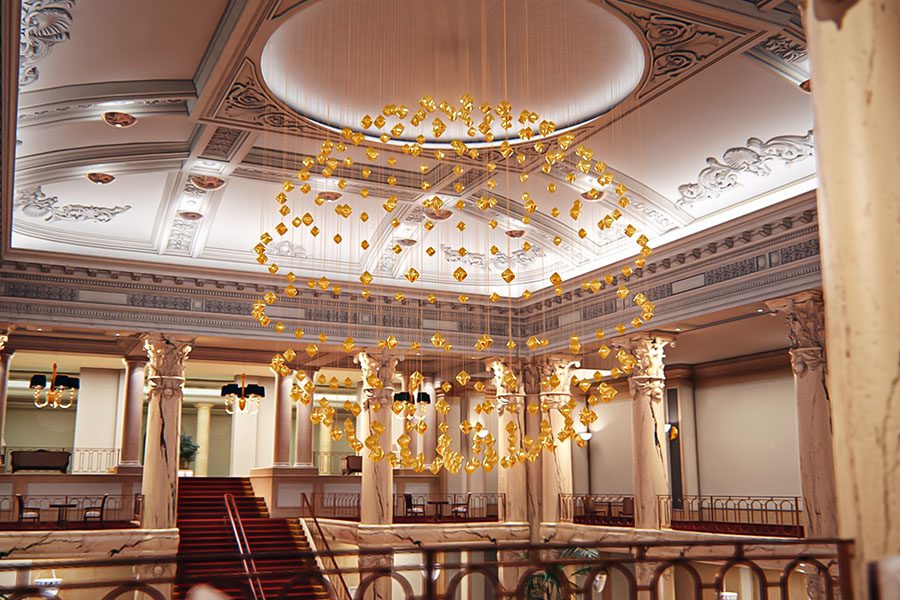
Kinetic sculpture can help resolve this by acting as a primary spatial anchor. In a tall atrium, a suspended installation can compress perceived scale, giving proportion and focus to a volume that might otherwise feel overly abstract. In a broad lobby, it can concentrate attention and create a stronger relationship between reception, waiting, lift cores, and lounge space. In some cases, it can even help distinguish public arrival space from semi-controlled circulation without resorting to hard separation.
The effect is not only visual. It is organizational. A kinetic element can help establish what matters first in the room. That is why it belongs in the same conversation as ceiling articulation, lighting hierarchy, vertical circulation visibility, and reception placement.
This role requires precision. If the installation competes with reception visibility, obscures security logic, or draws attention away from the actual path of entry, it undercuts the space. If it is too small, it disappears into the atrium. If it is too large, it overwhelms the room and reduces the legibility of the overall composition. The question is not simply whether the object is impressive, but whether it gives clearer order to the interior.
Some lobby sculptures remain visually striking yet spatially passive. They photograph well, but they do not actually shape how the room is read. The most successful kinetic installations do the opposite. They become inseparable from the user’s understanding of the lobby as a structured environment.

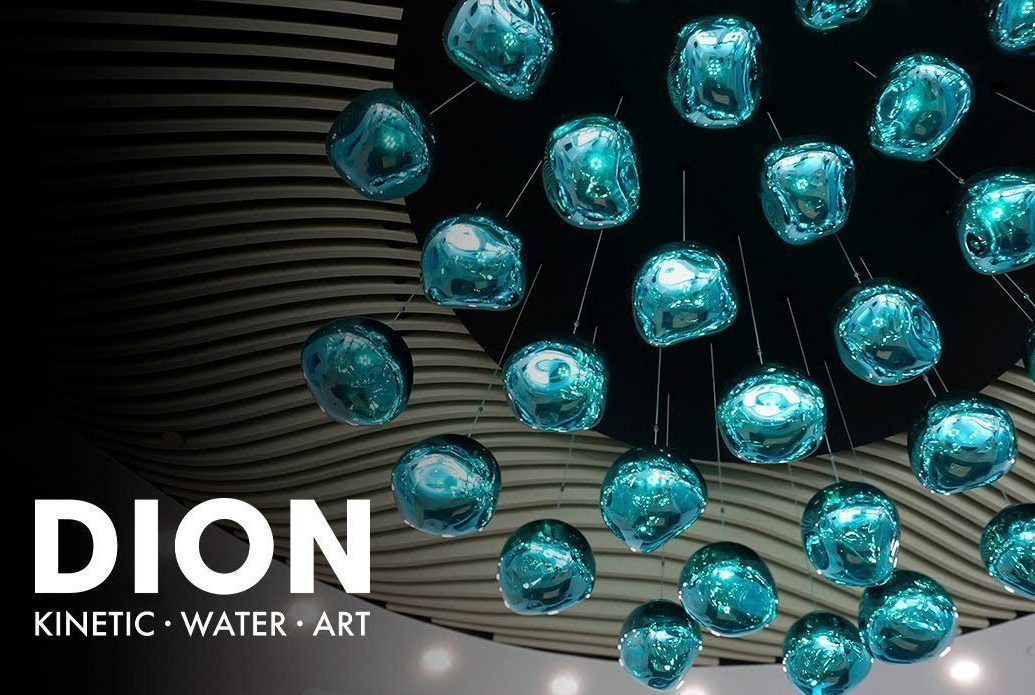


Outdoor plazas and corporate campus public realm
The renewed importance of campuses and amenity-rich office environments has also returned attention to the outdoor public realm. Corporate workplaces increasingly include central greens, social terraces, internal pedestrian routes, landscaped courtyards, and event-capable plazas. These spaces are meant to support gathering, hospitality, and informal work culture, yet they often struggle with the same issue seen in large interior environments: generosity without identity.
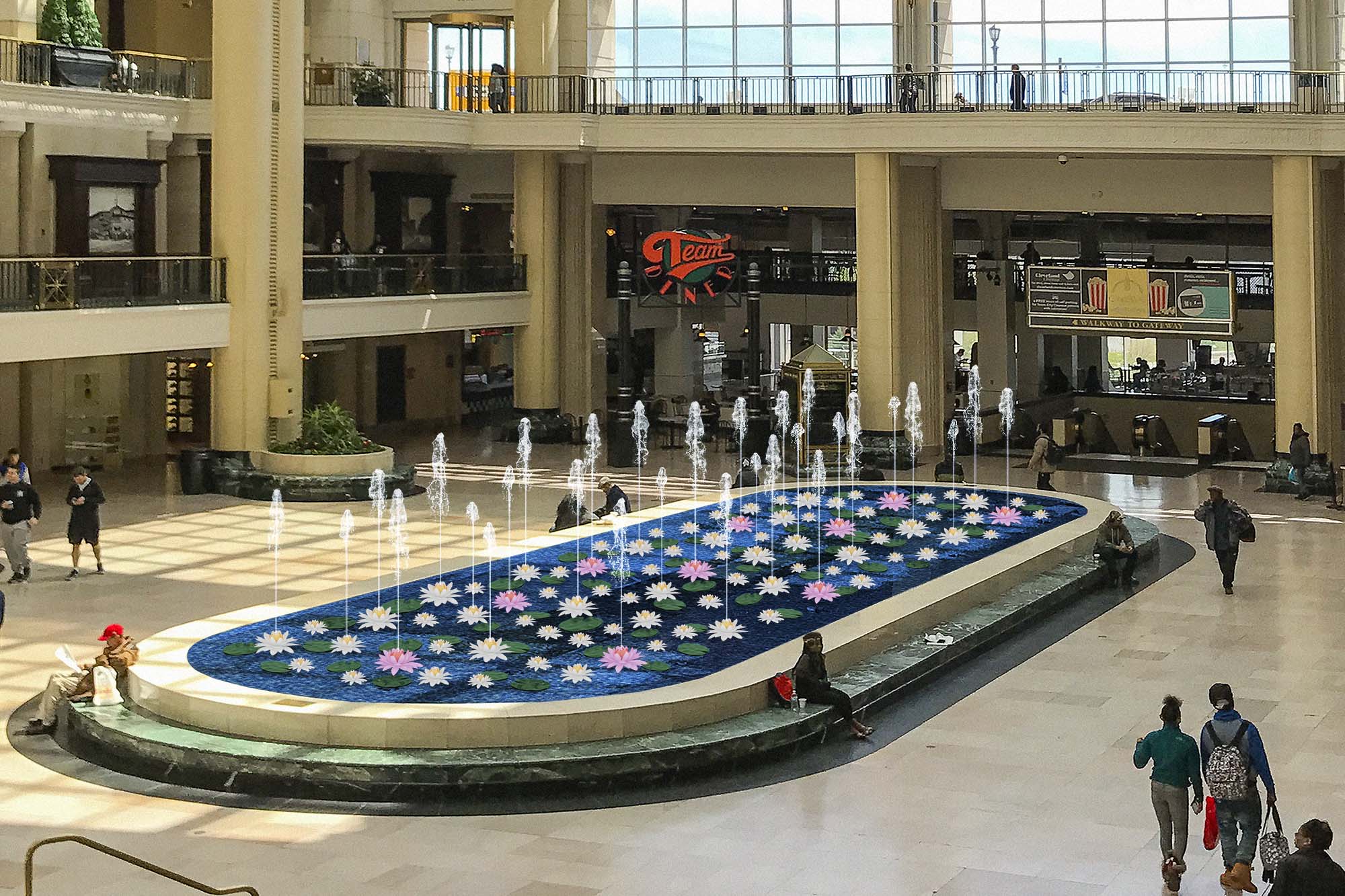
Kinetic sculpture can provide that missing center. In outdoor settings, it interacts with wind, light, weather, and the rhythms of the day, which makes the installation feel more deeply embedded in the life of the site. This responsiveness is especially valuable in campuses that aim to feel active even when they are not heavily programmed.
A campus plaza, for instance, may be well landscaped and architecturally consistent, yet still lack a clear point of orientation or social gravity. A kinetic landmark can identify that point. It can distinguish the main gathering area from circulation space, reinforce the relationship between surrounding buildings, and give the campus a memorable core that is visible from multiple approach routes.
This is where the scale of office campuses matters. At building scale, a kinetic sculpture can define an entry or an atrium. At campus scale, it can shape how the entire environment is mentally mapped. Employees and visitors may not remember every route, but they will remember the moving installation in the central square, the suspended landmark visible through the glazed lobby, or the piece that marks the transition between work and amenity zones.
Why early integration matters in commercial workplace projects
The strongest kinetic sculptures in office buildings and campuses are almost never late additions. They are integrated during concept design or early coordination, when the project team can still influence the relationship between the installation and the larger architectural system.
This matters for practical reasons. In lobbies and atria, kinetic works may affect structural loads, suspension strategy, ceiling coordination, lift access visibility, lighting design, maintenance access, and control infrastructure. In outdoor plazas, they may require wind analysis, drainage coordination, protective clearances, anchoring strategy, and service routing. These are not secondary technical issues. They shape whether the installation performs as part of the environment or remains a visually disconnected feature.
It also matters for spatial reasons. If the sculpture is introduced only after arrival logic, public-space hierarchy, and internal circulation are already fixed, it becomes harder for it to do meaningful architectural work. At that stage, the installation may still create a visual moment, but it is less likely to shape the building’s identity or strengthen the arrival sequence in a lasting way.
This is particularly important in US office developments where asset repositioning, tenant attraction, and amenity upgrades often happen under time and budget pressure. Teams may be tempted to use a landmark object as a late-stage differentiator. But if the project needs stronger identity, better arrival, or a more memorable shared environment, those ambitions are better served when the installation is part of the design logic early enough to influence it.
At DION ART STUDIO we work across art, architecture, and engineering which are most valuable precisely at this stage, because the central question is not simply what to design, but how the work will operate within a real workplace environment over time.

When kinetic sculpture underperforms
Kinetic sculpture does not automatically elevate a workplace environment. In some projects, it underperforms because it is expected to solve problems that belong to architecture, planning, or positioning strategy. A building with weak arrival logic, unresolved lobby hierarchy, or a generic campus public realm will not necessarily become distinctive simply by adding a moving object.
Another common issue is contextual mismatch. An installation may be technically advanced and visually dynamic yet wrong for the building’s atmosphere, tenant profile, or scale. A highly expressive piece may feel out of place in a corporate environment that depends on calm and focus. A restrained work may disappear in a large atrium that needs a stronger spatial center. In both cases, the issue is not the quality of the sculpture itself, but the relationship between the installation and the workplace it is meant to serve.
This is why kinetic sculpture must be evaluated not only as art, but as part of a broader workplace composition. The key questions are spatial and operational. Does the work strengthen identity without becoming branding shorthand? Does it make arrival clearer? Does it improve memory and atmosphere over time? Does it justify its technical and maintenance demands within the life of the building?
The most useful answer is often not the most spectacular option. In some projects, a restrained kinetic system integrated with light and volume will outperform a dramatic centerpiece. In others, a bold landmark is exactly what the campus needs to gain public presence. Value depends on fit, not intensity.


Kinetic sculpture as workplace infrastructure
The most mature office environments understand that identity, atmosphere, and spatial clarity are not separate concerns. They are part of the same built reality. Kinetic sculpture can contribute to all three at once. It can reinforce corporate character, enrich everyday experience, and help structure how the workplace is approached and understood.
For that reason, it is useful to think of kinetic sculpture not as a cultural extra, but as a form of workplace infrastructure. It does not replace architecture, landscape, or interior design. It strengthens them by giving the environment a stronger experiential center and a more memorable public-facing identity.
This is increasingly important in a commercial real estate landscape where office projects must justify why tenants and employees should want to be there. The strongest workplace environments are not only efficient. They are also spatially convincing. They feel composed rather than assembled, intentional rather than generic. Kinetic sculpture can help create exactly that condition when it is planned with architectural discipline and strategic clarity.
Kinetic sculptures have become increasingly relevant in office buildings and corporate campuses because they do more than add visual interest. They can sharpen arrival, reinforce corporate identity, structure lobbies and atria, activate outdoor public space, and improve the overall character of the workplace environment.
For developers, landlords, and corporate clients, their value lies in integration. A kinetic sculpture is most effective when it is conceived not as an isolated artwork, but as part of the larger architectural and experiential logic of the project. It should help the building or campus become more legible, more memorable, and more distinct in the daily life of the people who use it.
In premium workplace environments, that matters. The office is no longer just a container for work. It is part of how an organization presents itself to tenants, visitors, and its own teams. Kinetic sculpture, when developed with architectural intelligence and spatial precision, can become one of the most influential elements in shaping that experience.
Contact Us
Integrating a kinetic sculpture into an office building or corporate campus requires more than selecting a visually striking object. It involves understanding arrival sequence, workplace atmosphere, spatial hierarchy, technical coordination, tenant expectations, and the role the installation will play within the daily life of the environment.
At DION ART STUDIO, we work with developers, architects, and corporate clients to create kinetic and public art installations that function as part of the architectural system rather than as isolated additions. From concept development and spatial integration to engineering coordination, fabrication, and installation planning, our approach is shaped by the relationship between movement, identity, and built space.
If you are planning a headquarters, office lobby, campus plaza, workplace repositioning, or premium multi-tenant office project and exploring how kinetic sculpture can strengthen arrival, public identity, and workplace experience, this is the stage at which the conversation is most effective.
Because they introduce movement, memorability, and spatial identity into workplace environments, helping lobbies, plazas, and atria feel more distinctive and better structured.
Common locations include arrival forecourts, central plazas, lobbies, atria, amenity spaces, and major campus gathering points.
They create a public-facing symbol for the workplace and express values such as innovation, responsiveness, or precision through spatial experience rather than through graphics alone.
Yes, especially when they are used to create a stronger shared identity for the building or campus and improve the quality of common space used by tenants and visitors.
Ideally during early design stages, when placement, structure, services, lighting, circulation, maintenance, and spatial hierarchy can all be coordinated with the architecture.
Written by

Сo-founder & Creative director of DION ART
Master of Arts in Art Education, Public Art (School of the Art Institute of Chicago, USA)
Share this post