
How Interactive Lighting Transforms Public Spaces: Beyond Traditional Illumination
Lighting has always played an essential role in architecture. It defines spatial boundaries, highlights materials, creates atmosphere, and influences how people experience their surroundings.
However, contemporary lighting design is moving beyond illumination alone.
Today, light can respond to movement, react to human presence, change its visual character, and become an integral part of public art. Interactive lighting installations are transforming ordinary architectural environments into spaces where visitors become active participants rather than passive observers.
For architects, developers, and urban planners, this opens new possibilities for creating memorable public spaces without relying exclusively on traditional sculptures or decorative elements.

From Architectural Lighting to Interactive Art
Traditional architectural lighting is generally designed to provide visibility, emphasize architectural features, and establish a consistent atmosphere.
Interactive lighting introduces an additional dimension: behavior.
Instead of following only a predetermined schedule, lighting can change in response to specific inputs, including movement, touch, pressure, or environmental conditions.
This distinction fundamentally changes the relationship between people and space.
A conventional illuminated pathway guides visitors through an environment. An interactive pathway can acknowledge their presence, creating a sequence of illuminated elements as they move.
A traditional decorative wall provides a fixed visual composition. An interactive light wall can respond to visitors, transforming its appearance through programmed lighting scenarios.
In both examples, lighting becomes part of the experience rather than simply supporting it.

How Interactive Lighting Installations Work
Interactive lighting systems combine architectural design, electronic components, sensors, and control software.
Although the final installation may appear visually simple, its technical infrastructure requires careful coordination.
1. Sensors and Interaction Detection
Different technologies can be used depending on the intended visitor experience.
Pressure sensors: Detect physical contact or weight, making them suitable for interactive floors and illuminated stepping elements.
Capacitive touch sensors: Detect touch through compatible surfaces and can be integrated into walls, panels, and interactive objects.
Motion sensors: Detect movement within a defined area without requiring physical contact.
Proximity sensors: Allow lighting to react when visitors approach an installation.
Environmental sensors: Measure conditions such as wind or ambient light, allowing the installation to respond to its surroundings.
The selection of sensors should always begin with the intended interaction rather than the technology itself.
A public installation designed for children may require an entirely different interaction system from an artwork intended for a quiet hotel lobby.
2. LED Lighting and Control Systems
Programmable LED technology allows designers to control color, brightness, timing, and lighting sequences.
Depending on the design, individual fixtures or groups of fixtures can be controlled independently.
This creates opportunities for lighting compositions that evolve across an architectural surface.
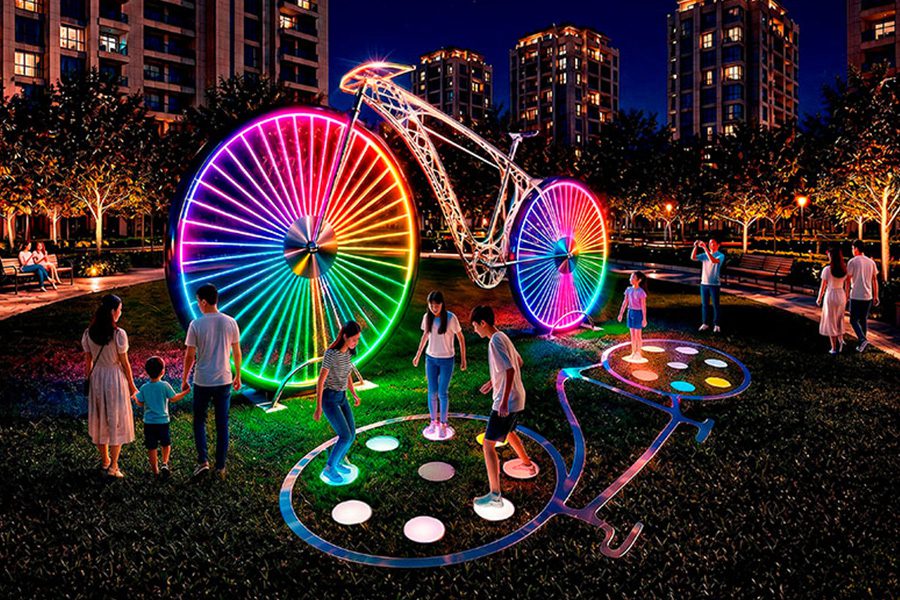
For example, a series of circular LED elements embedded into pavement can remain illuminated in white until someone steps onto a designated interaction point.
The activated element can then change to another color, creating a direct visual response to the visitor.
The result is a simple but meaningful interaction: the environment acknowledges human presence.
3. Programming and Behavioral Logic
The behavior of an interactive installation is determined by its control system.
Designers must consider several questions:
What activates the lighting?
How quickly should the installation respond?
What happens when multiple visitors interact simultaneously?
How long should an activated element remain illuminated?
What happens when nobody is interacting?
How does the installation return to its default state?
These decisions are as important as the physical design.
An effective interactive installation should feel intuitive. Visitors should understand the relationship between their actions and the visual response without requiring extensive instructions.

Interactive Lighting as a Tool for Placemaking
Placemaking focuses on creating public spaces that people recognize, enjoy, and want to return to.
Interactive lighting can contribute to this process by introducing a recognizable visual identity and encouraging participation.
Consider a residential courtyard containing a series of illuminated circles integrated into the pavement.
During the day, the installation can function as a subtle architectural feature. In the evening, the circles become visible light elements.
When visitors step onto selected circles, the lighting responds.
Children may explore the installation as a playful activity, while adults may experience it as an unexpected artistic feature within the landscape.
The same architectural element can support several forms of engagement without requiring a separate playground structure or freestanding sculpture.
This flexibility makes interactive lighting particularly relevant to mixed-use developments, residential communities, commercial plazas, and hospitality environments.
Why Integration Into Architecture Matters
One of the most important developments in contemporary interactive art is the integration of technology directly into architectural materials.
Rather than installing a separate object in the middle of a public space, designers can incorporate illuminated elements into floors, walls, ceilings, or landscape features.
This approach creates a closer relationship between architecture and artwork.
Interactive Floors
Recessed linear LED fixtures and illuminated glass elements can create geometric compositions within pavement.
When designed correctly, these elements can remain flush with the surrounding surface, preserving the continuity of the architectural space.
However, outdoor floor installations require careful consideration of structural loading, slip resistance, drainage, waterproofing, electrical protection, and maintenance access.


Interactive Walls
Walls can become responsive surfaces through integrated light panels, touch-sensitive components, or programmable lighting systems.
These installations are particularly effective in entrance areas, commercial interiors, and hospitality spaces where visual identity is important.
Interactive Ceilings
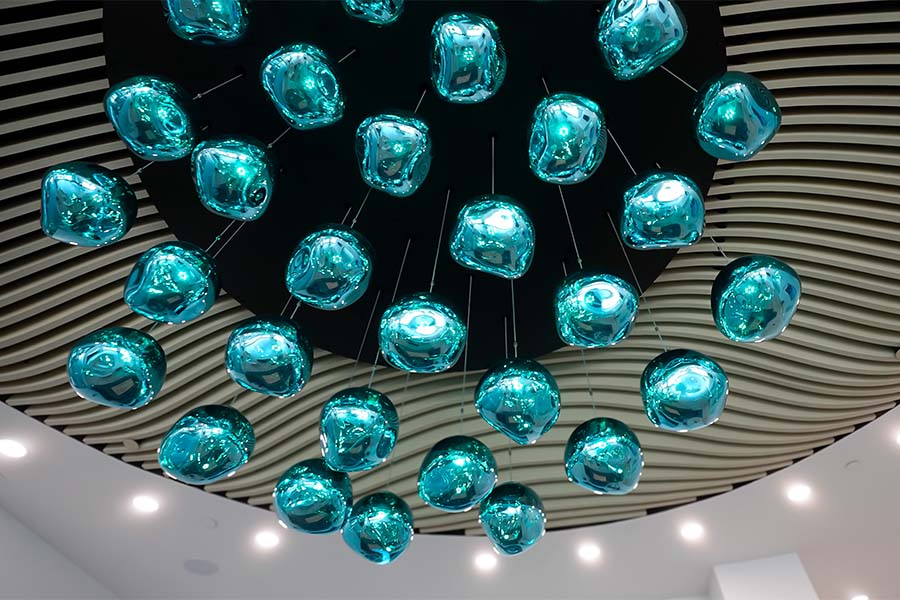
Suspended lighting elements can transform overhead space into an artistic composition.
Depending on the design, changes in color, intensity, or movement can create different visual experiences throughout the day.
Ceiling installations are especially useful in atriums and large interior spaces where floor area must remain unobstructed.


Designing for Real Human Behavior
One of the most common mistakes in interactive installation design is prioritizing visual complexity over visitor experience.
An installation does not necessarily become more engaging because it contains more sensors, colors, or animations.
In many cases, the most effective interactions are the simplest.
A visitor touches a surface. The light changes.
A child steps onto a circle. The circle illuminates.
Several people activate different elements. The installation forms a new composition.
These interactions create a clear relationship between action and response.
The goal is not to overwhelm visitors with technology but to make the interaction feel natural.
Designers must also consider how people behave in groups. An installation that works perfectly for one person may become confusing when ten visitors interact simultaneously.
For this reason, interaction scenarios should be tested during the design process, before manufacturing begins.
Technical Challenges of Interactive Lighting in Public Spaces
Public installations must perform reliably under conditions that differ significantly from controlled exhibition environments.
Durability and Maintenance
Interactive lighting in public spaces may experience frequent use, accidental impacts, moisture exposure, temperature fluctuations, and cleaning procedures.
Materials and components must be selected according to the specific installation environment.
Interactive Lighting for Developers and Commercial Properties
For property developers, interactive lighting offers possibilities beyond visual decoration.
A distinctive installation can help establish the identity of a development and differentiate its public spaces from conventional architectural environments.
It can also encourage visitors to spend time in areas that might otherwise function primarily as circulation zones.
In commercial and hospitality settings, interactive installations may become recognizable locations for photography, video, and social media content.
However, these benefits should not be treated as automatic outcomes.
The success of an installation depends on its location, visibility, design quality, accessibility, visitor behavior, and ongoing operation.
The most valuable installations are those that contribute to the everyday experience of a place while maintaining a strong visual identity.
The Future of Interactive Lighting in Architecture
As control systems, sensors, and lighting technologies continue to develop, the boundaries between architectural lighting and public art are becoming increasingly fluid.
Future public spaces may incorporate responsive surfaces that change according to occupancy, time of day, or environmental conditions.
The most interesting opportunities are not necessarily found in increasingly complicated technology.
They are found in more thoughtful relationships between architecture, people, and light.
A successful interactive installation transforms a simple human action into a meaningful spatial experience.
And sometimes, that experience begins with something as simple as stepping onto a circle of light.
Contact Us
Ready to create a destination that attracts and retains attention? Explore our portfolio or contact the DION ART STUDIO team to discuss your project.
At DION ART STUDIO, we design and engineer kinetic and public art installations as part of a project’s spatial and commercial strategy — from concept and integration to fabrication and implementation — ensuring each installation becomes a defining element of the destination.
An interactive lighting installation is an artistic or architectural lighting system that changes in response to inputs such as touch, movement, pressure, proximity, or environmental conditions.
Interactive lighting can be integrated into public plazas, residential courtyards, shopping centers, hotels, office buildings, museums, and other indoor or outdoor architectural environments.
Yes. Outdoor installations require appropriately specified fixtures, weather-resistant electrical components, safe mounting systems, drainage solutions, and materials suitable for local environmental conditions.
Programmable lighting follows predefined sequences or schedules. Interactive lighting responds to real-time inputs, allowing visitors or environmental conditions to influence its behavior. A single installation can combine both approaches.
Maintenance requirements depend on the complexity of the system, environmental exposure, component selection, and accessibility. Designing for reliable operation and easy component replacement can help manage long-term maintenance costs.
Written by

Сo-founder & Creative director of DION ART
Master of Arts in Art Education, Public Art (School of the Art Institute of Chicago, USA)
Share this post