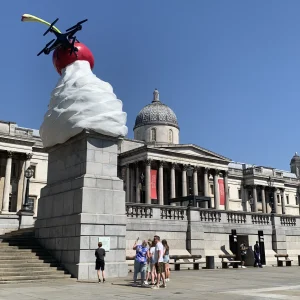
Urban sculptures as architectural landmarks
In contemporary urban development, sculpture increasingly functions as part of the architectural framework rather than as an isolated artistic element. Across airport terminals, waterfront promenades, corporate campuses and cultural districts, urban sculptures are used to anchor public space and structure how people perceive large environments.
Within complex architectural projects, sculpture often performs the role traditionally associated with towers or monumental buildings. Positioned within plazas, atriums or landscape axes, a sculpture can establish hierarchy, guide orientation and create a visual focus within the spatial composition.

Over time, these works frequently become recognizable architectural landmarks, helping visitors navigate large public environments. When integrated thoughtfully into the design of a project, sculpture can evolve into a lasting public art landmark that defines the identity of a place.
Role of landmarks in urban architecture
Urban environments depend on recognizable spatial markers. Landmarks help people form mental maps of complex spaces and provide visual orientation within dense urban fabric.
Historically, buildings such as cathedrals or civic towers fulfilled this role. In contemporary developments, however, sculptural interventions increasingly perform a similar function. A city landmark sculpture can define a central plaza, mark an entrance or anchor a major circulation node.
This approach is particularly effective in large-scale projects such as airports, mixed-use developments and cultural districts. These environments often include expansive public areas where traditional architectural cues may be limited. Sculptural elements provide visual clarity within these large spaces.
For developers and architects, landmarks also reinforce the identity of a project. A carefully positioned sculpture can transform a plaza or atrium into a recognizable destination within the broader city.
Why sculptures work as landmarks
Ready to create a landmark that defines your space? Explore our portfolio or contact the DION ART STUDIO team to discuss your project.
Urban sculpture today operates far beyond decoration. Within contemporary masterplans, it becomes a spatial anchor — a reference point that structures perception, guides movement, and gives identity to large-scale environments. From plazas and waterfronts to airport terminals and mixed-use districts, sculptural landmarks help people read and navigate complex spaces through clear visual hierarchy.
While static sculptures establish permanence and symbolic presence, kinetic and interactive installations introduce an additional layer of experience. Movement, light, and responsive systems transform these landmarks into dynamic elements that evolve throughout the day, reinforcing the connection between architecture, environment, and human activity.

Scale also plays an important role. A monumental sculpture positioned within an open plaza establishes a strong center within the composition of the space. Surrounding circulation patterns and gathering areas often begin to orient themselves around the artwork.
Over time, these works may evolve into iconic city sculptures that become part of the visual identity of a district. Through photography, media and everyday use of the space, the sculpture becomes embedded within the collective image of the city.
In this way, sculptural interventions contribute directly to city identity art within contemporary urban environments.

Kinetic sculptures as modern landmarks
In recent years, movement has become an increasingly important dimension of urban sculpture design. Kinetic works introduce time and transformation into public space, allowing sculptures to evolve rather than remain static.
Motion adds another layer to spatial perception. Panels may rotate with the wind, suspended elements may shift subtly above circulation zones, or programmed systems may choreograph patterns of movement throughout the day.
We often approach kinetic installations as spatial devices rather than purely artistic objects. When integrated into architecture, movement can animate large volumes, guide attention and introduce rhythm into otherwise static environments.
At DION ART STUDIO, our work explores this intersection between art, architecture and engineering. We develop kinetic installations, sculptural fountains and large-scale public artworks designed specifically for complex public environments such as airports, urban plazas and commercial centers.
In these contexts, kinetic installations operate as both urban art installations and architectural elements, shaping the atmosphere and identity of the space.

Examples of sculptural landmarks in global cities
Around the world, numerous cities demonstrate how sculpture can become a defining element of the urban landscape. In many cases, these works operate at the scale of architecture, shaping the perception of public space and becoming inseparable from the identity of the place.
Chicago offers one of the most recognizable examples. In Millennium Park, Anish Kapoor’s reflective sculpture widely known as Cloud Gate has transformed the central plaza into one of the most photographed spaces in the city. The smooth mirrored surface captures fragments of the skyline, the movement of visitors and the changing light of the sky, turning the sculpture into an evolving urban experience rather than a static object.

In London, Antony Gormley’s Angel of the North illustrates how a monumental sculpture can influence the perception of an entire region. Standing on a hill overlooking major transportation routes, the massive steel figure has become a visual symbol of northern England and a landmark visible from far beyond the immediate site.
Another compelling example can be found in New York’s Hudson Yards district. Thomas Heatherwick’s Vessel functions somewhere between sculpture and architecture. Rising from the central plaza as a network of interconnected staircases, the structure acts as a sculptural centerpiece that organizes movement and observation within the new development.

Paris offers a different approach in the business district of La Défense, where numerous large sculptures are integrated into the open plazas between office towers. These works introduce moments of artistic expression within an otherwise rigid corporate landscape and help structure pedestrian movement across the district’s elevated platforms.
In Bilbao, the area surrounding the Guggenheim Museum demonstrates how sculpture can reinforce architectural identity. Louise Bourgeois’s giant spider Maman stands near the museum entrance, creating a powerful visual contrast with Frank Gehry’s flowing titanium façade. Together, the building and the sculpture form a composition that defines the public space around them.
Asian cities have also embraced sculptural landmarks within contemporary architecture. In Singapore’s Changi Airport, a kinetic installation composed of hundreds of suspended metallic elements transforms a departure hall into a constantly shifting visual environment. The slow choreography of movement creates a calm focal point within the otherwise fast-paced flow of travelers.
Seoul offers another example through Jonathan Borofsky’s Hammering Man. Positioned among modern office towers, the tall kinetic sculpture performs a slow repetitive movement that reflects the rhythm of urban labor. Its scale and motion make it one of the most recognizable sculptural elements in the city’s central business district.

Rotterdam demonstrates yet another direction, where large sculptural artworks are integrated into contemporary architectural developments. In areas such as the Markthal district, artworks embedded within the architecture itself function as monumental visual statements that define the character of the space.
These examples illustrate how sculptural works increasingly operate as architectural landmarks within modern cities. Whether placed in a cultural plaza, integrated into a commercial district or suspended within a major transportation hub, a well-designed sculpture can anchor public space and shape the identity of an entire development.
For architects and urban designers, these projects demonstrate that sculpture is no longer simply an artistic addition to architecture. It is a spatial instrument capable of organizing movement, establishing hierarchy and giving large urban environments a recognizable visual identity.
Integration with urban design
The success of sculptural landmarks depends largely on how they are integrated into the overall urban composition. Placement, scale and spatial relationships are critical.
Sculptures are often positioned along visual axes, within central plazas or at intersections of major pedestrian flows. In airport terminals, for example, sculptural installations frequently mark key gathering zones and help travelers orient themselves within large interior spaces.
In parks and waterfront developments, sculptures may anchor open landscapes that might otherwise feel visually diffuse. Their presence introduces hierarchy and structure into the spatial composition.
Lighting design further strengthens this role. At night, illumination transforms sculptures into visible markers that continue to guide perception within the urban environment.
Design principles of urban sculptures
Designing sculpture for public environments requires balancing artistic expression with spatial clarity. Scale is one of the most important considerations. The sculpture must maintain presence within expansive spaces while remaining proportionate to surrounding architecture.
Material durability is equally critical. Sculptures placed in public environments must withstand weather conditions, environmental exposure and continuous human interaction. Metals such as stainless steel or aluminum are often used for their resilience and visual longevity.
Equally important is the relationship between sculpture and its surroundings. Successful landmark sculpture design responds to the architectural language of the site and reinforces the spatial narrative of the development.
Through thoughtful integration, sculpture becomes part of the architecture rather than an isolated object.

Urban sculpture has become a powerful tool in contemporary placemaking. When integrated into architecture and landscape design, these works function as architectural landmarks that structure space and strengthen the identity of large developments.
From monumental installations in civic plazas to dynamic kinetic works in airport terminals, sculptural interventions shape how people experience public environments.
For architects and developers working on complex urban projects, sculpture offers a way to transform large spaces into places with clear orientation, strong identity and lasting cultural value.
Contact Us
Ready to create a landmark that defines your space? Explore our portfolio or contact the DION ART STUDIO team to discuss your project.
Urban sculpture today operates far beyond decoration. Within contemporary masterplans, it becomes a spatial anchor — a reference point that structures perception, guides movement, and gives identity to large-scale environments. From plazas and waterfronts to airport terminals and mixed-use districts, sculptural landmarks help people read and navigate complex spaces through clear visual hierarchy.
While static sculptures establish permanence and symbolic presence, kinetic and interactive installations introduce an additional layer of experience. Movement, light, and responsive systems transform these landmarks into dynamic elements that evolve throughout the day, reinforcing the connection between architecture, environment, and human activity.
At DION ART STUDIO, we design and engineer sculptural installations that function as both artistic statements and architectural infrastructure. Our works shape the identity of places, creating memorable landmarks that define how people experience and remember contemporary urban environments.
Written by

Сo-founder & Creative director of DION ART
Master of Arts in Art Education, Public Art (School of the Art Institute of Chicago, USA)
Share this post