How Interactive Public Art can change throughout the year without being reinstalled
Public art is often designed as a permanent visual statement, but permanence does not have to mean visual repetition.

With the right combination of lighting, modular elements, digital content, responsive systems, and programmable controls, one installation can evolve throughout the year without being physically rebuilt.
For developers, architects, hospitality operators, and public-space owners, this creates a different model of placemaking: the artwork remains structurally consistent while its atmosphere, behavior, and visual identity change with seasons, holidays, events, or cultural programming.

Permanent structure, changing experience
The strongest seasonal installations are not temporary decorations attached to a permanent artwork. They are designed from the beginning as adaptable systems.
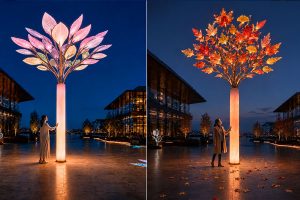
The primary structure may remain unchanged for years, while selected layers can be reprogrammed or exchanged. Lighting scenes can shift from warm autumn tones to colder winter compositions. Interactive behavior can change for a festival or public event. Media content can evolve without altering the physical form of the artwork.
This allows the installation to remain recognizable while continuing to feel current.

Why American developments increasingly depend on destination logic
In many US markets, conventional real estate advantages are no longer enough to ensure public distinction. High-quality finishes, prominent architects, curated landscaping, and strong tenant brands remain important, but they do not automatically create a memorable development. As a result, developers increasingly rely on strategies that can intensify identity and extend the public life of a project beyond its core commercial function.
This is particularly visible in phased mixed-use districts, lifestyle destinations, hospitality-led public realms, Class A repositionings, and large waterfront redevelopment projects where the site must perform socially as well as financially. A project may contain office, residential, dining, retail, and cultural elements, but if the public realm does not generate attraction in its own right, the development risks functioning only as a convenient aggregation of uses rather than as a place with real urban presence.
Destination logic changes the ambition of the project. It shifts the question from what the development contains to why people choose to come there, stay there, and return there. It also changes how public-facing elements are valued. A kinetic installation is no longer judged only by whether it enriches the space aesthetically. It is judged by whether it helps the place accumulate magnetic force.
In American developments, this is especially important because many projects operate in highly competitive environments where perception moves quickly. One district competes with another. One hospitality-led precinct competes with another. Office campuses compete through employee experience and public-facing distinctiveness. Retail destinations compete not only through tenant mix, but through atmosphere and memorability. In that setting, the destination value is not ornamental. It is part of the project’s long-term commercial resilience.
Lighting as the simplest layer of transformation
Programmable architectural lighting is one of the most effective ways to change the character of an installation without rebuilding it.
RGBW LED systems, addressable lighting, dynamic control software, and scheduled scenes can allow the same sculpture to behave very differently throughout the year.
A single piece might appear quiet and minimal during ordinary evenings, become warmer and more animated during winter holidays, or use different color logic for a cultural event.
The important distinction is that lighting should not feel like an effect added after the design is complete. It needs to be integrated into the materiality, geometry, and viewing conditions of the artwork from the beginning.


Interactive behavior can change without changing the artwork
Interactive installations can also be updated through software rather than hardware.
A touch-sensitive surface may trigger one type of response in summer and a different one during a special event. A motion-responsive installation can change the speed, duration, intensity, or color of its behavior depending on the programmed scenario.
This makes seasonal adaptation possible without requiring new sensors or a new structural system.
The artwork remains physically the same, but the relationship between people and the installation can evolve.
Modular components create another level of flexibility
Some projects benefit from physical elements that are designed to be exchanged.
These may include translucent panels, decorative inserts, suspended components, graphic layers, or lightweight architectural elements that can be replaced without touching the main structure.
The key in this type of interactive art is to separate the permanent engineering system from the seasonal layer.
Seasonal transformation can support placemaking
For public plazas, mixed-use developments, shopping destinations, hotels, and cultural spaces, this flexibility can have a wider impact than visual variety alone.
A changing installation gives people a reason to notice the space again.
The same artwork can support different moments across the year: winter holidays, spring openings, summer events, national celebrations, retail activations, or cultural programming.
This helps a permanent installation function less like a fixed object and more like a long-term platform for public experience.
Adaptability has to be engineered from the beginning
A project only becomes truly adaptable when its technical infrastructure is designed for change.
That may include programmable lighting systems, accessible control hardware, modular mounting details, weather-resistant connectors, replaceable media elements, remote programming capability, and clear maintenance access.
Without this planning, seasonal updates can become expensive, fragile, or disruptive.
The goal is not to make every part of the installation changeable. It is to identify which layers should remain permanent and which layers are most valuable to evolve.
Not every seasonal change has to be dramatic
Adaptability does not always mean turning the installation into a completely different object.
In many cases, subtle changes are more effective.
A shift in color temperature, the rhythm of light, the way the work reacts to visitors, or the timing of movement can be enough to create a different emotional atmosphere.
The strongest systems preserve the identity of the artwork while allowing its expression to evolve.
Long-term value for developers and public spaces
For developers and property owners, an adaptable installation can extend the relevance of a single capital investment.
Instead of replacing artwork or introducing temporary decorative structures every season, the same installation can support multiple visual identities and programming scenarios over time.
This can reduce repeated installation work while giving the space a stronger sense of continuity.
The result is a permanent artwork with a changing public presence.
Designing public art as an evolving system
At DION ART STUDIO, we see public art not only as a fixed object, but as a system that can respond to place, technology, people, and time.
Lighting, motion, sensors, modular components, and control systems can all be used to create installations that remain structurally permanent while continuing to evolve.
The question is not how often an installation should change.
It is which parts of the experience should remain constant, and which parts can adapt without losing the identity of the work.
Contact Us
Ready to create a destination that attracts and retains attention? Explore our portfolio or contact the DION ART STUDIO team to discuss your project.
Creating destination value through a kinetic installation goes beyond selecting a visually striking object. It becomes a spatial catalyst — organizing public life, guiding movement, and shaping how people experience and remember a place over time.
While static elements provide clarity and permanence, kinetic and interactive installations introduce change through movement, light, and responsive systems, increasing engagement and reinforcing presence within everyday urban rhythms.
At DION ART STUDIO, we design and engineer kinetic and public art installations as part of a project’s spatial and commercial strategy — from concept and integration to fabrication and implementation — ensuring each installation becomes a defining element of the destination.
Yes. Programmable lighting, digital content, interactive behavior, and modular elements can allow the same installation to change visually or behaviorally while its main structure remains in place.
Lighting scenes, colors, media content, interactive responses, sound, selected surface elements, and modular decorative components can all be designed for seasonal updates.
Not necessarily. If adaptability is engineered into the project from the beginning, updates can often be handled through programming or planned component replacement rather than major construction.
Yes, provided the fixtures, control systems, electrical infrastructure, and access points are designed for outdoor conditions and long-term maintenance.
Yes. Sensor logic, lighting responses, motion sequences, and media behavior can often be reprogrammed for holidays, events, or seasonal scenarios without changing the physical installation.
Written by

Сo-founder & Creative director of DION ART
Master of Arts in Art Education, Public Art (School of the Art Institute of Chicago, USA)
Share this post