
How Kinetic Installations Shape Identity in Mixed-Use Districts
Mixed-use districts are rarely judged only by the quality of their buildings. They are judged by whether the entire environment feels coherent enough to be remembered as a place rather than experienced as a sequence of separate uses. Offices, residences, retail, hospitality, leisure, and public space may all be present, yet the district can still feel fragmented if nothing binds those layers into a shared spatial identity. This is where kinetic installations have become increasingly relevant.
In large mixed-use developments, identity is not formed through branding alone. It emerges through repeated public experience: how people arrive, where they pause, what they remember, how they describe the place to others, and what continues to draw them back at different times of day. A kinetic installation can play a serious role in that process. It does more than animate a plaza or add visual distinction. It can become the element that gives a district a recognizable center of gravity and a more legible public character.
That matters because mixed-use projects are inherently unstable in use. They are occupied by different groups, at different hours, with different expectations. Office users move through them in the morning and early evening. Residents read the district through daily repetition and comfort. Visitors arrive at slower, more selective moments, often looking for atmosphere, landmarks, and social cues. Hospitality and dining push activity into the night. Public space has to hold all of these rhythms without becoming generic. Kinetic installations are uniquely suited to that challenge because they introduce continuity through movement while remaining open to changing patterns of use.

Mixed-use districts need more than a collection of uses
Developers often talk about mixed-use as a formula of program: residential above, retail below, office nearby, public realm connecting the whole. But spatially, that formula is not enough. Many mixed-use districts still feel like adjacent assets rather than integrated environments. The uses coexist, but the place does not accumulate a clear identity.
The reason is simple. Program creates activity, but not necessarily coherence. A district only begins to feel whole when its public realm becomes more than circulation space between buildings. It has to develop recognizability, rhythm, and memory. That usually depends on a small number of strong spatial anchors rather than on uniform quality everywhere.
This is why district-scale identity cannot rely only on façades, signage, or landscape treatment. Those elements matter, but they often remain too distributed to create a memorable center. A kinetic installation can do something more concentrated. It can give the district a focal point that remains visually and emotionally active over time. In large public environments, that kind of focal presence helps transform a development from a well-designed real estate package into a place with civic and cultural presence.

Why spatial anchors matter at district scale
Mixed-use districts are read differently from single buildings. People rarely understand them all at once. They build mental maps through repeated fragments: the plaza where they meet, the promenade they cross after work, the corner visible from the hotel terrace, the central space that feels socially charged even before an event begins.
A true district marker works because it helps organize those fragments. It allows visitors and regular users alike to orient themselves through a stable point of reference. In this sense, kinetic installations are not just identity objects. They are tools of spatial hierarchy. They distinguish primary public space from secondary space and help users understand where the district’s core actually is.
This is especially important in mixed-use environments where the public realm must remain active across changing tempos. A kinetic element visible from a plaza, a pedestrian spine, or a central court can hold the district together visually even when the surrounding program shifts from day to night. It becomes part of the district’s structure of recognition.
That is why the strongest kinetic installations in mixed-use projects are rarely located randomly. They are placed where the district needs a center, a marker, or a spatial pivot. Their success depends on urban position as much as on visual design.
Plazas, promenades, and transitions are where identity is formed
Identity in mixed-use projects is rarely formed at the parcel line. It is formed in the spaces between uses: the plaza linking office and retail, the promenade connecting hospitality and residential edges, the forecourt where public arrival becomes social occupation, the transition zone where circulation slows and people begin to linger.
These are precisely the spaces where kinetic installations can have the greatest effect. A large plaza may already be generous in dimension and high in material quality, yet still feel spatially unresolved if no element gives it hierarchy. A promenade may connect key destinations, yet remain only a passage route if nothing encourages longer attention. A kinetic work can alter both conditions. It can intensify a public node without hardening it. It can create a visible and behavioral anchor without obstructing circulation.
Movement matters here because it increases the perceptual life of the space. A static sculpture may function as a landmark, but a kinetic installation introduces change across time. That change gives people a reason to look again. It also helps the district remain perceptually active outside moments of formal programming. The public realm becomes less dependent on events alone because part of its attraction is already built into the spatial field.
This is one of the reasons mixed-use districts benefit so strongly from kinetic work. Their public spaces need to perform repeatedly, not only ceremonially. They need to stay legible and attractive across ordinary occupations, not just during launch campaigns or cultural events.
Daytime and evening use demand different kinds of presence
One of the defining conditions of mixed-use development is temporal overlap. The district must remain convincing under very different modes of use. In the morning, it may function through office flows and service rhythms. At midday, through short dwell, retail use, and food traffic. In the evening, through dining, hospitality, leisure, and residential return. The same public space is therefore read through changing social expectations.
A kinetic installation can help unify those shifts because movement behaves differently under changing light, density, and duration of stay. During the day, it may work as a visible orientation marker and urban focal point. In the evening, it may become more atmospheric, helping the district retain identity when architectural surfaces recede and lighting becomes more decisive. It can maintain continuity across temporal change without forcing the district into a single mood.
This is particularly useful in projects that want to avoid the common problem of mixed-use environments feeling active only during one part of the day. A kinetic installation cannot solve weak programming on its own, but it can help the district feel intentionally alive across longer hours of occupation. It supports repeat engagement because the experience of the work is not exhausted in a single viewing condition.
For developers, that matters commercially. Public identity that survives both daytime circulation and evening destination use is far more valuable than identity that depends on one peak moment.


A photogenic object is not the same as a district marker
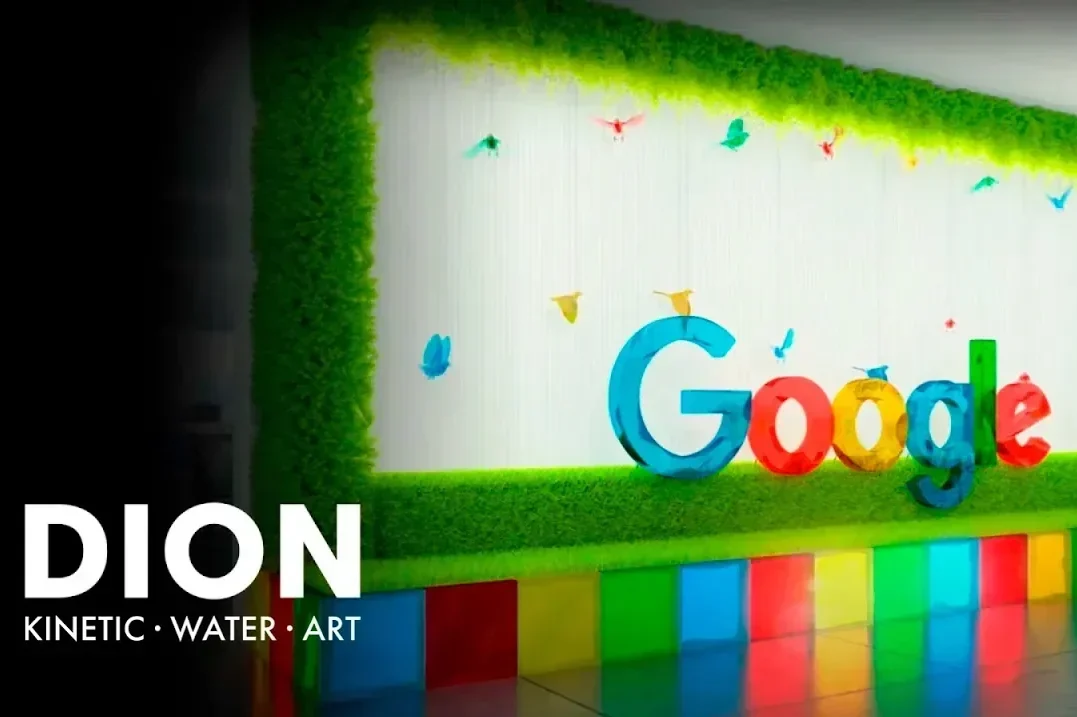
Many developments now aim for “Instagrammable” features in their public realm. But there is an important difference between a photogenic object and a true district marker. A photogenic object may generate images. A district marker helps shape how the environment is understood, remembered, and used.
The difference lies in spatial function. If the installation only works from one angle, has little relationship to surrounding movement, and does not strengthen the reading of the district, it may still be visually successful but remain urbanly weak. It generates attention without building place.
A true district marker works at more than the image level. It is visible from meaningful approach routes. It reinforces a central node or transition. It becomes part of how users describe and navigate the district. It survives repeated use because it is tied to the structure of the environment rather than to novelty alone.
This is where kinetic installations can outperform static gestures. Because they change, they remain active in memory. But that only happens when the movement serves a broader spatial role. Motion without placement is just display. Motion with urban purpose becomes identity.

Movement strengthens memory, orientation, and destination value
Memory is one of the most underestimated components of placemaking. People return to districts they can describe, locate, and emotionally recognize. In mixed-use developments, that recognition is often built through recurring elements that help users connect different visits into one coherent mental image.
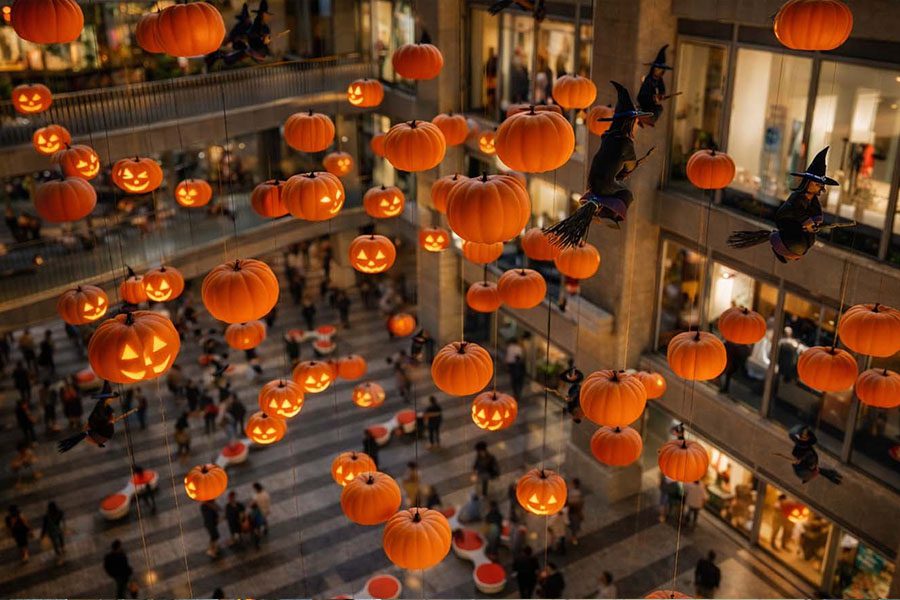
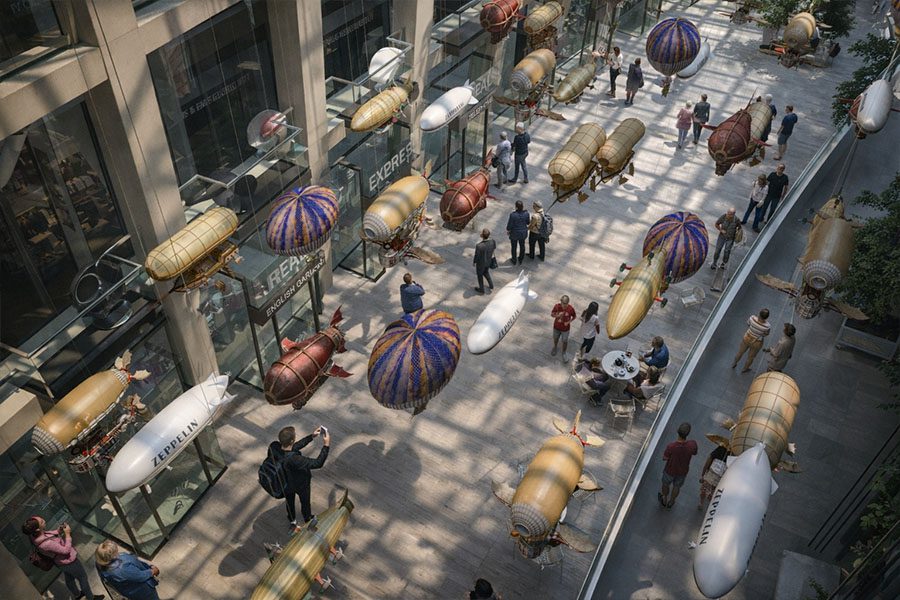
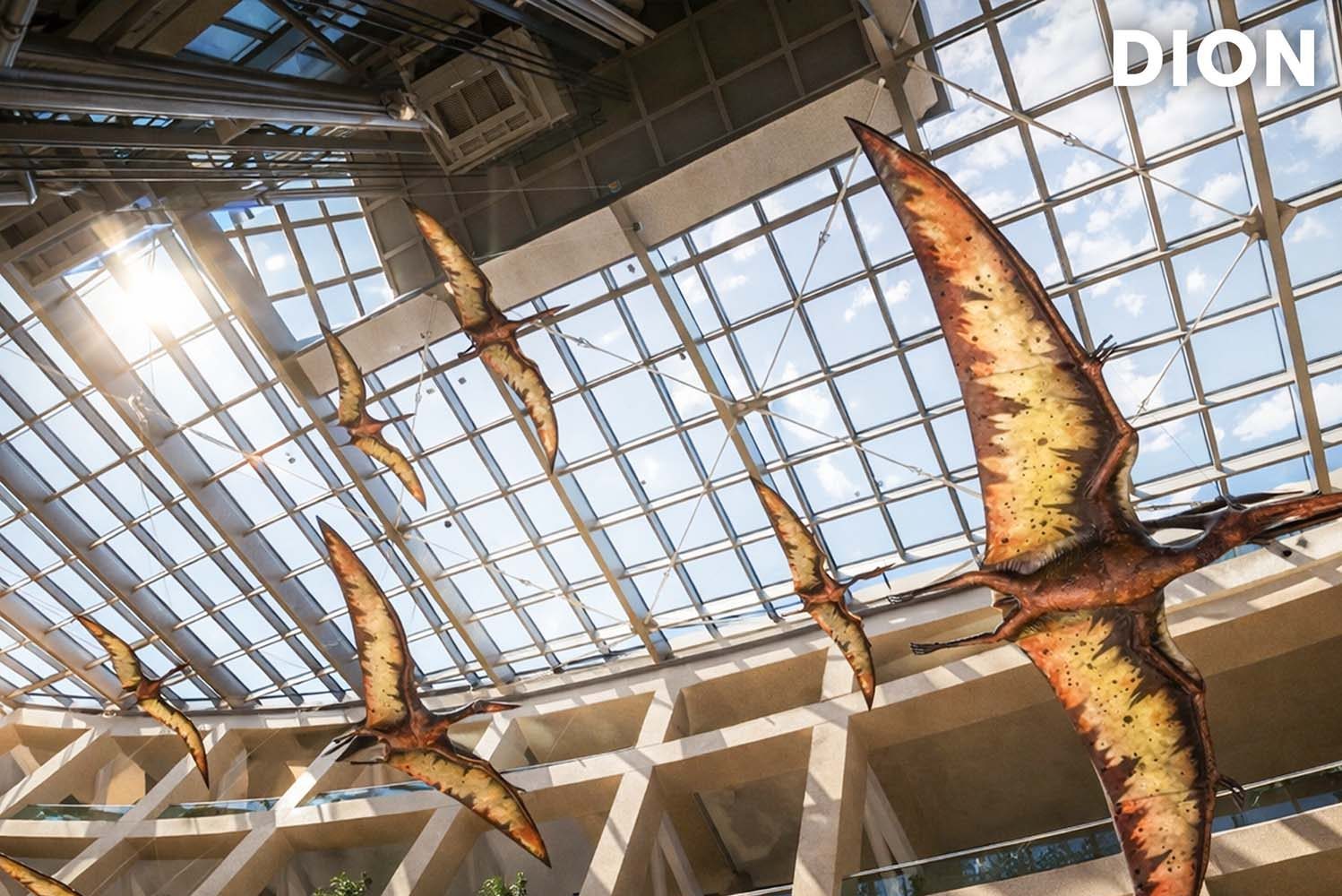
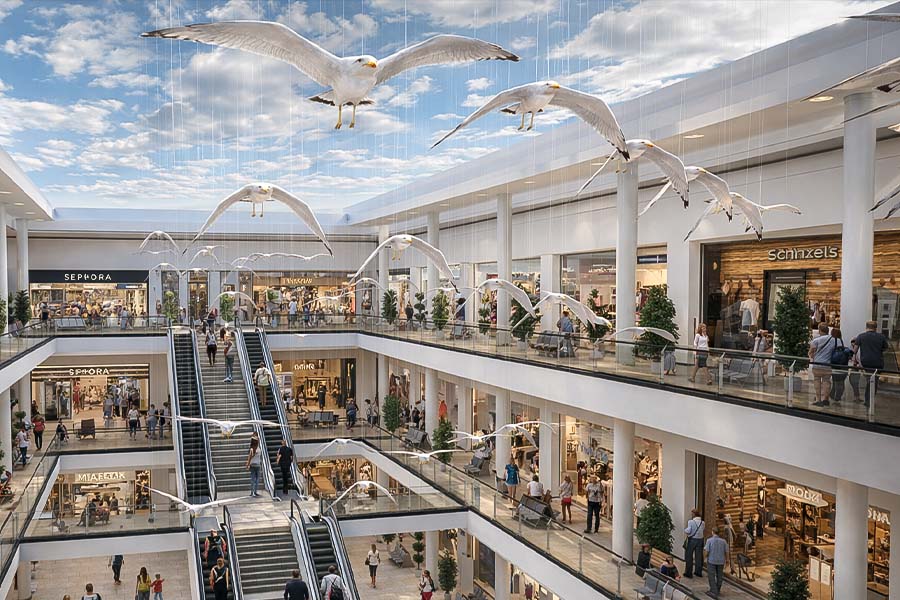
Kinetic installations are powerful because they bind image and event together. A person does not only remember the object. They remember that the space shifted, shimmered, rotated, or responded while they moved through it. That makes the encounter more durable. The installation becomes part of how the district is recalled.
This also strengthens orientation. In large mixed-use environments, users rely less on abstract plans than on visible anchors. A kinetic work at a central plaza, arrival court, or public crossing can help users understand where the district’s main social and spatial center lies. Over time, this improves how the whole development is read.
The same logic extends to destination value. A district becomes more magnetic when its public realm contains elements that reward return and support narrative memory. Kinetic movement helps because it keeps the space perceptually alive. But the key is always integration. The installation must strengthen the district’s identity rather than simply compete for attention within it.
Why integration matters more than spectacle
The most effective kinetic installations in mixed-use projects are not inserted late as visual upgrades. They are planned as part of the public-realm strategy from the beginning. That is because their success depends on more than the object itself. It depends on sightlines, circulation, scale relationships, lighting logic, maintenance access, structural coordination, and how the work aligns with the district’s hierarchy of spaces.
This is where many projects go wrong. They decide they need a landmark after the urban logic is already fixed. The result may still be striking, but it often behaves as an isolated feature rather than a district-forming element. It photographs well, yet does little to organize the place.
At DION ART STUDIO, this is exactly where kinetic installations become most meaningful. The work matters most when it is conceived not as an art layer to be added at the end, but as part of the way a mixed-use district defines its center, its transitions, and its public memory. In these projects, art, architecture, and placemaking are not separate disciplines. They are already working on the same problem.
Mixed-use districts depend on more than program and architectural quality. They depend on whether the public realm develops enough identity, memory, and coherence to function as a place in its own right. Kinetic installations can play a major role in that process because they provide visible anchors, strengthen spatial hierarchy, support orientation, and keep public space perceptually active across changing hours and user groups.
Their value lies not only in movement, but in placement and integration. A kinetic installation becomes powerful at district scale when it helps define where the mixed-use environment begins to feel socially and spatially whole.
That is the difference between an attractive object and an element that truly shapes district identity.

Contact Us
Ready to create a landmark that defines your space? Explore our portfolio or contact the DION ART STUDIO team to discuss your project.
Designing a sculptural landmark for a mixed-use district goes beyond creating a visually striking object. It acts as a spatial anchor — structuring perception, supporting navigation, and helping people understand complex environments across plazas, retail zones, and transit interfaces.
While static sculptures provide permanence, kinetic and interactive installations add a dynamic layer through movement and light, increasing engagement and reinforcing the role of the landmark within everyday public life.
At DION ART STUDIO, we design and engineer sculptural installations from concept to implementation, ensuring each piece functions as an integral element of the architectural environment — shaping identity, orientation, and long-term destination value.
Written by

Сo-founder & Creative director of DION ART
Master of Arts in Art Education, Public Art (School of the Art Institute of Chicago, USA)
Share this post

