Interactive Floor Installations: Transforming Everyday Spaces into Engaging Experiences
How responsive lighting, creative technology, and thoughtful design can turn ordinary floors into memorable architectural experiences.
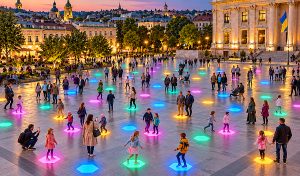
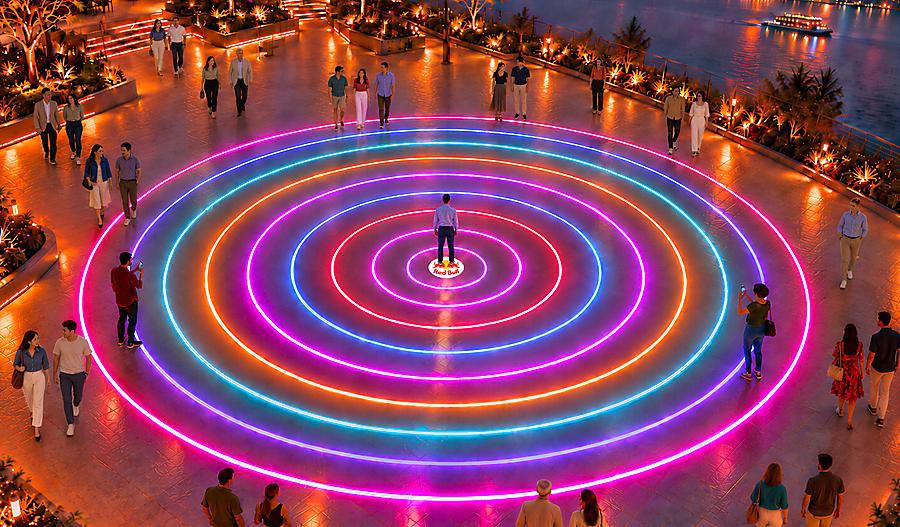
Imagine walking through a hotel lobby and watching a circle of light respond beneath your feet. Or entering a public plaza where illuminated pathways react to movement, inviting visitors to explore, play, and interact with their surroundings.
These experiences are becoming an exciting direction in contemporary public art and architectural design.
Interactive floor installations transform surfaces we walk on every day into opportunities for engagement, creativity, and connection.
At DION Art Studio, we explore how light, technology, and spatial design can work together to create Interactive environments that are both visually compelling and functional.
Beyond Traditional Public Art
Traditional public art is often designed to be observed. Interactive installations invite people to become part of the experience.
Instead of simply walking past an artwork, visitors can activate it through their presence, movement, or touch.
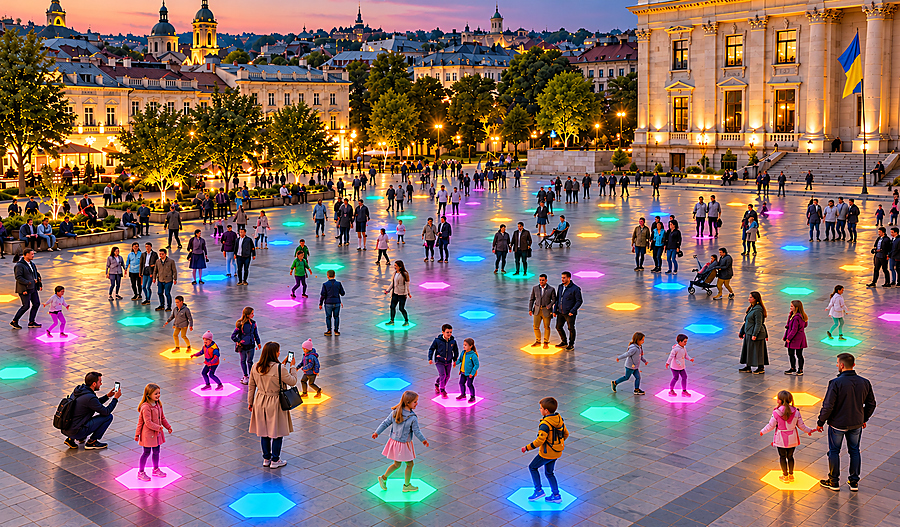
A glowing circle might change color when someone steps onto it. A sequence of illuminated lines could guide visitors through a plaza. Multiple interactive elements might respond to different people simultaneously, creating an experience that changes throughout the day.
The installation is no longer just an object within a space. It becomes part of how people experience that space.
This opens new possibilities for architects, developers, hospitality brands, and urban designers looking to create environments that feel more engaging and memorable.
One Concept, Endless Design Possibilities
One of the greatest advantages of interactive floor installations is their versatility.
They are not limited to a particular shape, material, or architectural style.
At DION Art Studio, we develop concepts using a variety of geometric arrangements and interactive elements, including:
Illuminated circles and concentric rings that respond to visitors stepping onto designated areas.
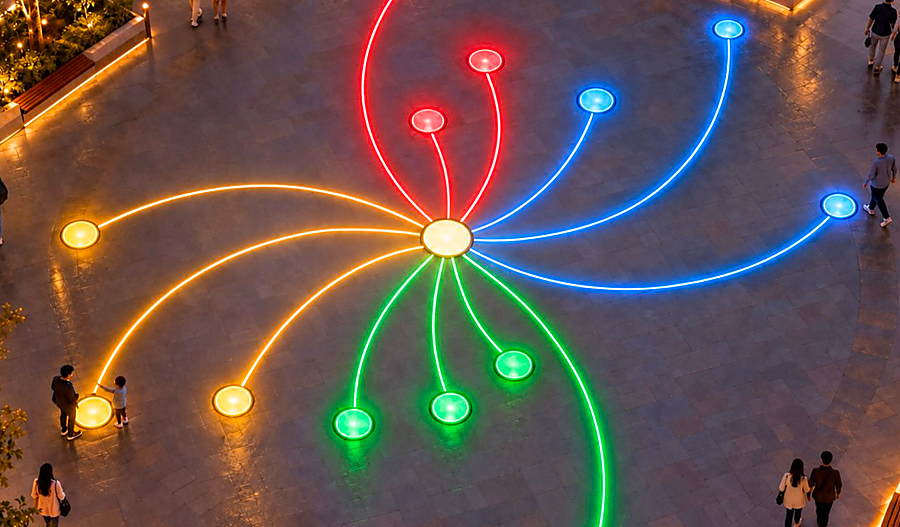
Linear lighting patterns that create interactive pathways and directional experiences.
Organic and custom-shaped elements inspired by nature, movement, or architectural geometry.
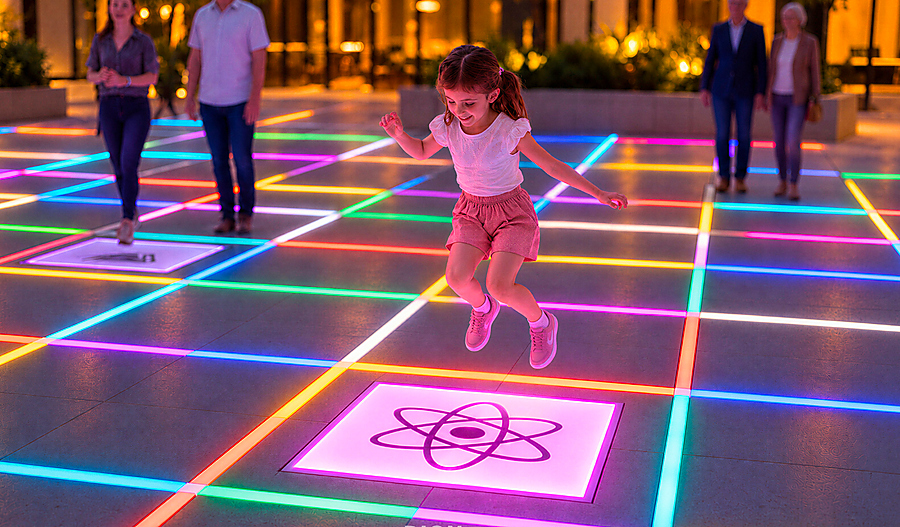
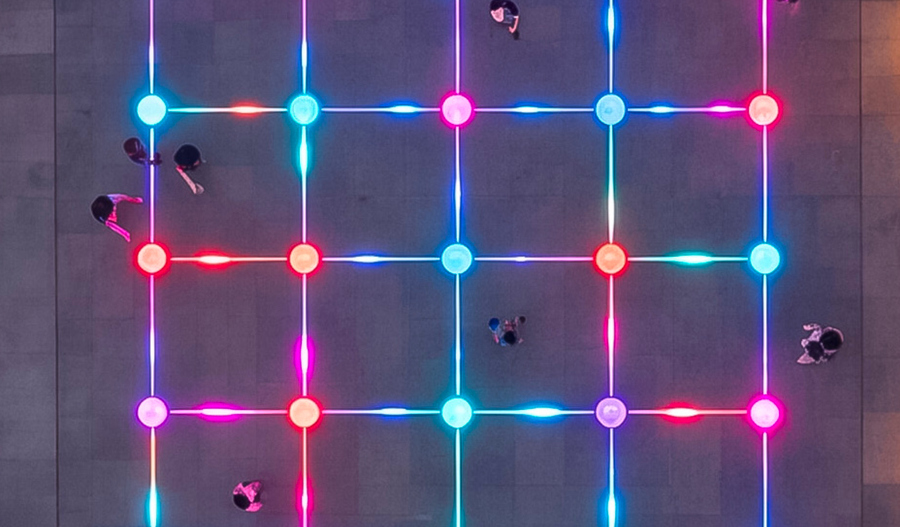
Interactive grids and playful compositions that encourage exploration and group participation.
Branded installations incorporating logos, symbols, or custom visual identities.
These elements can be arranged individually or combined into larger compositions, allowing each installation to respond to the character and purpose of its location.
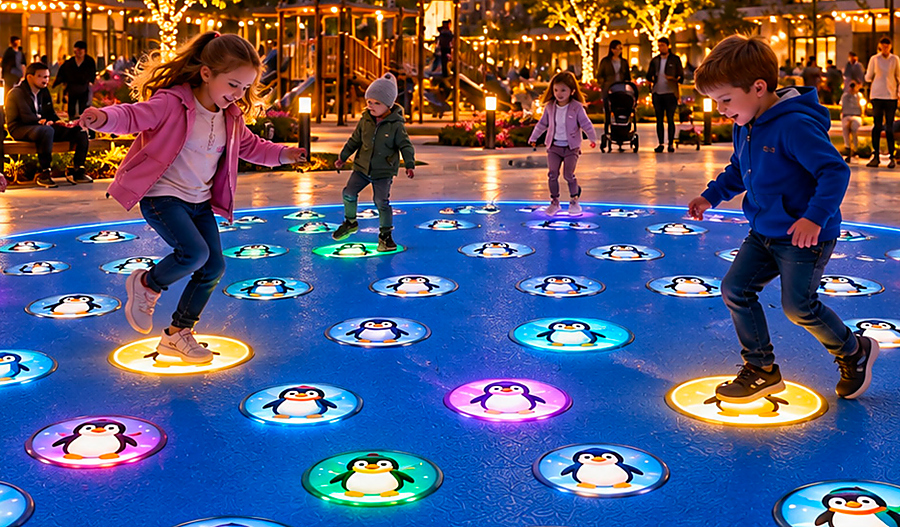
A minimal series of white illuminated rings might complement a contemporary corporate lobby, while a colorful interactive playground could bring energy to a residential courtyard or family-oriented destination.
The underlying idea remains the same: turning movement into an experience.
Designed for Indoor and Outdoor Environments
Interactive floor installations can be developed for a wide range of architectural settings.
Hotels and Hospitality
In hotels and resorts, interactive lighting can create a distinctive arrival experience.
Imagine an illuminated pathway leading guests toward the entrance, or a responsive floor installation becoming a focal point within the lobby.
For hospitality brands, these installations offer an opportunity to create a recognizable atmosphere that extends beyond conventional interior decoration.
Public Plazas and Urban Spaces
Public spaces become more inviting when people have a reason to stop, explore, and participate.
Interactive floor installations can introduce moments of discovery into pedestrian areas, waterfront promenades, cultural districts, and mixed-use developments.
They can also contribute to the nighttime identity of a destination through carefully integrated architectural lighting.
Residential Developments
In residential communities, interactive installations can transform shared courtyards and outdoor recreational areas into places for play and social interaction.
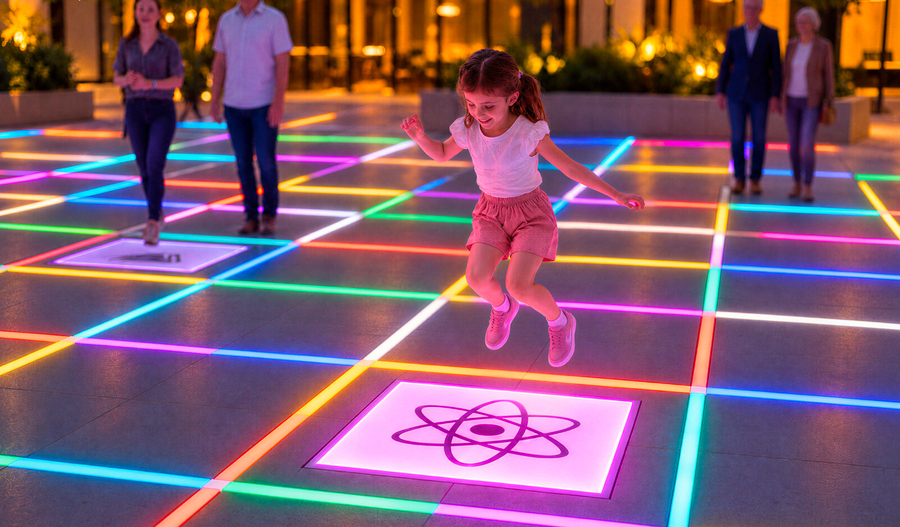
Children can discover how light responds to their movements, while adults experience an unexpected artistic feature within their everyday surroundings.
Retail and Commercial Destinations
For shopping centers, entertainment venues, and branded environments, interactive floors can create engaging experiences that encourage visitors to explore a space.
Custom graphics, illuminated symbols, and responsive elements can also be integrated into brand-specific concepts.

Customization Is the Key
Every architectural project has its own requirements.
That is why interactive floor installations should not be approached as one-size-fits-all products.
Their design can be adapted through several layers of customization.
Shape and geometry: From simple circles and lines to complex compositions and custom silhouettes.
Scale and layout: From a small interactive feature to a large installation integrated across an entire plaza.
Color and lighting: Static illumination, programmed color changes, and responsive lighting sequences.
Interaction: Individual touch or pressure activation, proximity-based responses, and coordinated effects across multiple elements.
Materials: Carefully selected translucent surfaces, architectural paving, and structural components appropriate to the intended environment.
Brand integration: Custom logos, symbols, and visual elements developed around a specific identity or destination.
The result is an installation designed around the architecture rather than added to it as an afterthought.

Technology That Feels Effortless
The most successful interactive experiences are often the ones that feel intuitive.
Visitors should not need instructions to understand how to participate.
A person steps onto an illuminated element, and the light changes. Someone moves across a series of interactive points, and the installation responds.
Behind these simple interactions is a carefully coordinated system of sensors, lighting controls, programming, and physical components.
Depending on the project, interactive floor installations may incorporate programmable LED lighting, pressure-sensitive activation, proximity detection, and customized control software.
At DION Art Studio, we approach programming and testing as essential parts of the creative process, ensuring that the intended visual experience and the technical system are developed together.
For outdoor installations, additional considerations include weather protection, drainage, slip resistance, structural loading, maintenance access, and long-term durability.
These factors are addressed during engineering and technical development to create solutions appropriate for each installation site.

An Experience That Can Evolve Over Time
Another exciting possibility is the ability to change an installation’s visual behavior without replacing the physical artwork.
Where the lighting and control systems support it, different programs can be created for different occasions.
A public plaza might feature soft white illumination during regular evenings, colorful interactive sequences during festivals, and a custom lighting composition for a seasonal celebration.
A hotel could adapt its lighting experience for special events, while a commercial destination might introduce branded sequences for a particular campaign.
This flexibility allows one physical installation to support multiple experiences over time.
Instead of creating a static design that remains unchanged for years, architects and property owners can consider an interactive feature that evolves with its environment.
The Future of Interactive Architectural Spaces
As technology becomes increasingly integrated into the built environment, the boundary between architecture, public art, and interactive experience continues to evolve.
Floors, pathways, plazas, and gathering areas no longer need to remain passive elements.
They can become responsive environments that connect people with the spaces around them.
At DION Art Studio, we see interactive floor installations as a flexible design language with applications across hospitality, residential, commercial, and public environments.
From minimal illuminated geometry to complex custom-designed compositions, each installation offers an opportunity to make architecture more engaging.
Because the most memorable spaces are not always the ones we simply look at. They are the ones we become part of.
Contact Us
Ready to create a destination that attracts and retains attention? Explore our portfolio or contact the DION ART STUDIO team to discuss your project.
At DION ART STUDIO, we design and engineer kinetic and public art installations as part of a project’s spatial and commercial strategy — from concept and integration to fabrication and implementation — ensuring each installation becomes a defining element of the destination.
An interactive floor installation is a technology-driven art experience that responds to human movement, footsteps, or touch. Using integrated LED lighting, sensors, and custom programming, these installations transform ordinary floors and public spaces into engaging environments where visitors become part of the artwork.
Yes. Interactive floor installations can be designed for both indoor and outdoor environments, including public plazas, parks, waterfronts, hotel entrances, shopping centers, and residential developments. Outdoor installations require appropriate weather-resistant materials, waterproofing, drainage, and electrical protection.
Absolutely. Interactive floor installations can feature circles, geometric patterns, illuminated lines, custom symbols, logos, or entirely original compositions. Their dimensions, colors, lighting effects, and interactive behaviors can be tailored to the architecture, brand identity, and purpose of each location.
Depending on the technology selected, installations can detect footsteps, pressure, or movement through integrated sensors. When visitors interact with designated areas, the system can activate lighting effects, change colors, or trigger programmed sequences. Multiple visitors can also participate simultaneously, creating a shared interactive experience.
Yes. Interactive floors can encourage movement, exploration, creativity, and social interaction. They are particularly suitable for family-friendly public spaces, playgrounds, residential communities, and entertainment destinations. Designs can incorporate educational symbols, playful patterns, and interactive games.
Written by

Сo-founder & Creative director of DION ART
Master of Arts in Art Education, Public Art (School of the Art Institute of Chicago, USA)
Share this post