Kinetic Installations for Hotels and Luxury Developments in the US
In the United States, hospitality environments are increasingly shaped by experience as much as by architecture. Hotels, branded residences, and luxury developments are no longer judged only by location, finishes, or service standards. They are evaluated through atmosphere, memorability, and the emotional quality of arrival. In this context, kinetic installations have become more than visual statements. They are emerging as spatial instruments that help define how a property is perceived from the first approach to the final impression.
This is especially relevant in luxury hospitality, where the project must communicate distinction immediately and sustain it across every layer of the guest journey. A lobby, porte-cochère, arrival court, pool terrace, wellness zone, or signature restaurant cannot feel generic if the development is positioned as premium. Kinetic installations respond to this demand in a way static décor often cannot. They introduce movement, anticipation, and temporal change into environments that depend on mood, perception, and recall.
For developers, hoteliers, architects, and hospitality operators, the value of a kinetic installation lies not only in visual impact. Its importance comes from the way movement can structure arrival, reinforce brand identity, animate transitional spaces, and turn architectural settings into destinations with a more distinctive public image. In high-end hospitality, that is not a peripheral effect. It is part of the commercial and experiential logic of the property itself.

Why hospitality spaces are read differently from other environments
Hospitality is not experienced in the same way as an office building, a shopping center, or even a mixed-use development. A hotel guest enters the environment with different expectations and a different psychological tempo. In a workplace, clarity and repetition dominate the experience. In hospitality, what matters more is the controlled atmosphere: the shift from public to private, from city to retreat, from movement to pause, from visibility to intimacy.
This is why spatial sequencing in hotels and luxury developments requires a different degree of emotional calibration. Guests do not simply need to know where to go. They need to feel that they have entered a setting with a distinct internal logic. The threshold matters more. The pace of transition matters more. The relationship between spectacle and calm matters more. A hospitality environment succeeds not when it is merely legible, but when it feels composed.
Kinetic installations belong naturally within this condition because they work through time as well as form. A moving artwork can slow perception, focus attention, and introduce a subtle rhythm into the arrival experience. Unlike static objects, which are often read once and absorbed into the background, kinetic works continue to participate in how the space is felt over time.
This is one reason they have become increasingly relevant to luxury developments in the US, where many premium properties compete within a similar architectural vocabulary. Stone lobbies, high ceilings, controlled lighting, refined materials, and landscape-driven arrival are all common. Kinetic installations help break that sameness by giving the environment a distinctive temporal identity.

Arrival choreography and the first impression of luxury
Few building types depend on first impressions as heavily as hotels and luxury developments. Guests begin evaluating the property before they cross the threshold. The drive-up sequence, drop-off experience, entry court, porte-cochère, glazing reveal, and lobby focal point all influence whether the property feels aspirational, serene, dramatic, exclusive, or ordinary.
This is why so many hospitality projects invest heavily in arrival choreography. Lighting, landscape, sound, scent, water, material changes, and ceiling height are all used to shape the psychological transition into the property. Kinetic installations can intensify this transition because they create a visible center of attention that unfolds in time rather than appearing as a fixed decorative gesture.
A well-positioned installation can be perceived from the approach before it is fully understood. It may appear framed through glazing, aligned with the central axis of the lobby, or positioned beyond the arrival court so that the guest moves toward it almost unconsciously. This creates anticipation before reception, which is one of the most valuable spatial effects in luxury hospitality. The guest feels guided not by signage or overt theatricality, but by a more atmospheric logic.
This role is especially important in urban luxury hotels, where the project may have limited exterior space and must create a sense of distinction quickly. In those conditions, the relationship between porte-cochère, entry threshold, and lobby depth becomes critical. A kinetic installation can compress or extend the perceived depth of that sequence, making a relatively compact arrival feel more layered and deliberate.
The strongest projects understand that the installation should not compete with operational clarity. Guests must still read reception, concierge, circulation paths, and lounge zones immediately. A kinetic work succeeds in hospitality when it gives the threshold a stronger identity without turning the arrival into visual confusion.
Kinetic installations as part of luxury brand identity
In hospitality, brand identity is rarely communicated through graphics alone. Guests do not remember a hotel because of a logo at reception. They remember it through atmosphere, sequence, and the specific moments that become attached to the property in memory. In this sense, luxury branding is spatial before it is verbal.
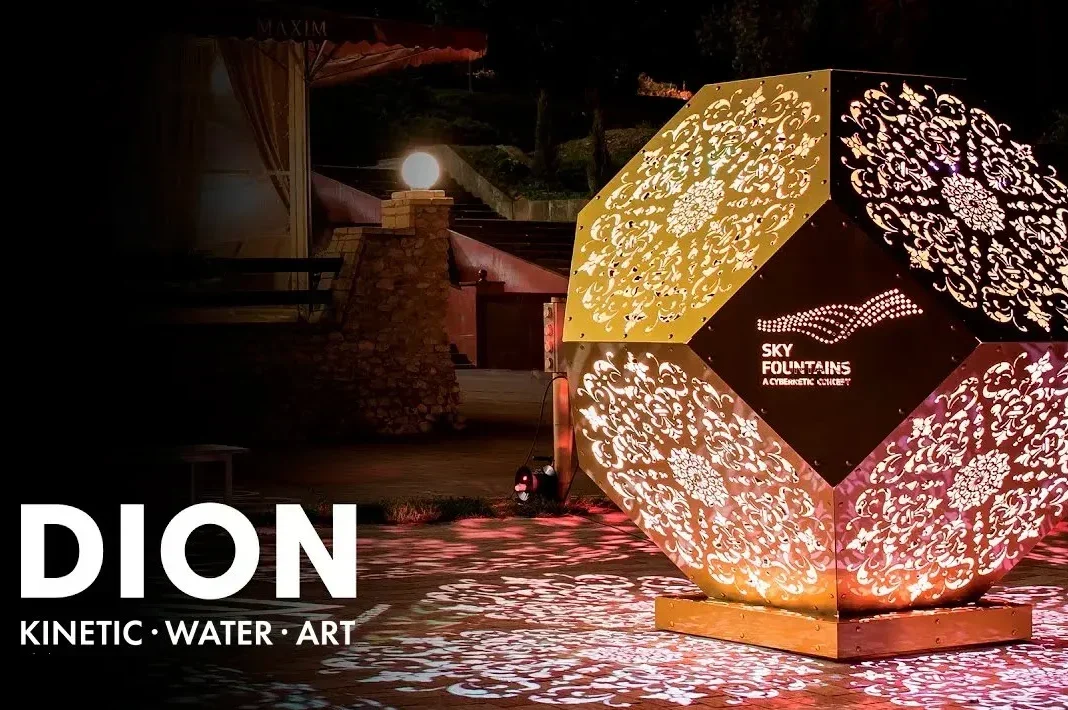
Kinetic installations are especially effective in this role because movement gives the property its own visual rhythm. A static sculpture can create a landmark, but a kinetic installation introduces temporal life, which makes a place feel curated rather than merely finished. That distinction matters in luxury hospitality, where the environment must appear controlled and composed, but never inert.
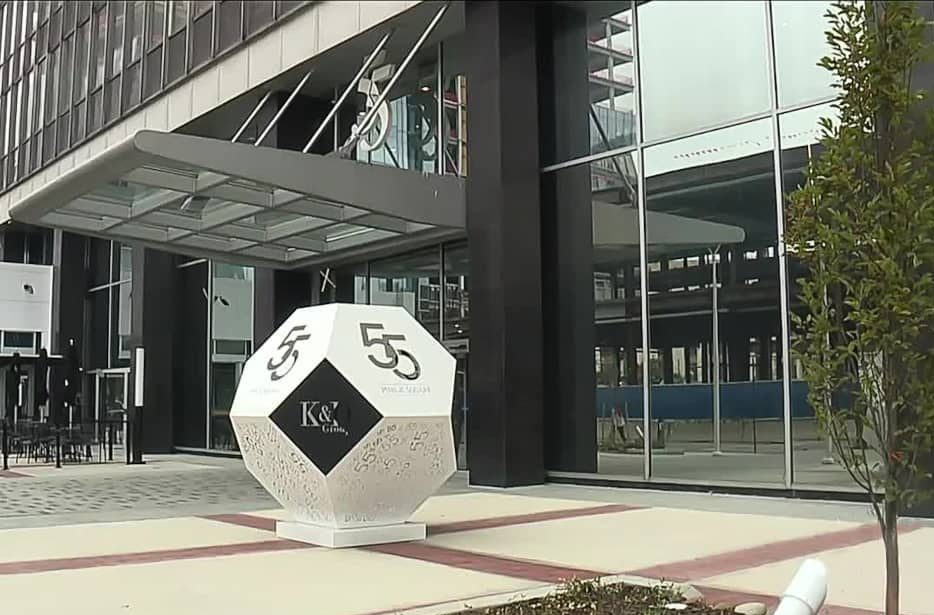
For branded hotels and luxury developments, this can be highly valuable. A kinetic installation in a lobby, atrium, entry court, or signature public space can become the image most associated with the property. It appears in photography, editorial features, social media, guest content, and marketing campaigns. More importantly, it becomes the spatial signature of the development itself.
What makes this effective is not just visual distinctiveness, but alignment. The movement, material language, lighting response, and overall tone of the installation must correspond to the identity of the property. A calm, coastal luxury resort may need a different kinetic language than a high-gloss urban hotel or a branded residence positioned around privacy and discretion. The strongest hospitality installations do not simply attract attention. They reinforce the emotional register of the brand.

Hotel, resort, and branded residence: why the same strategy does not work for all
Although these projects are often grouped together under “luxury development,” they do not operate through the same spatial logic. A hotel is shaped by temporary occupation, continual arrival, and a high intensity of first impressions. A resort is shaped more by progression, leisure tempo, open-air transitions, and the relationship between architecture and landscape. A branded residence or luxury serviced development depends on repeat use, private identity, and a more controlled balance between prestige and domestic calm.
Because of this, the role of kinetic installations must shift according to the hospitality model. In a city hotel, the installation often works best as an arrival anchor or lobby-defining element. It needs to create immediate distinction within a compact sequence and help the property feel more memorable from the first encounter. In a resort, the installation may work more effectively as part of a landscape or open-air spatial sequence, where movement interacts with wind, water, sunlight, and changing weather conditions. In a branded residence, by contrast, the installation may need to operate with greater restraint, supporting identity without overpowering the quieter, more residential tone of the environment.
This distinction matters because many luxury developments fail not through lack of ambition, but through lack of calibration. What works in a lobby designed for short, intense guest impressions may feel too performative in a residential arrival space. What works beautifully in a resort landscape may feel too diffuse in a compact urban hotel. The success of a kinetic installation in hospitality depends not only on the artwork itself, but on whether its tempo, scale, and visibility match the rhythm of the property.
Lobby volumes, atria, and the atmosphere of vertical space
Large hotel lobbies and atria often present a familiar challenge: they are generous in scale, but emotionally underdefined. Height alone does not create atmosphere. Expensive materials, tall glazing, and curated furniture can produce a premium impression, yet the room may still feel visually neutral if nothing gives the volume a distinct center.
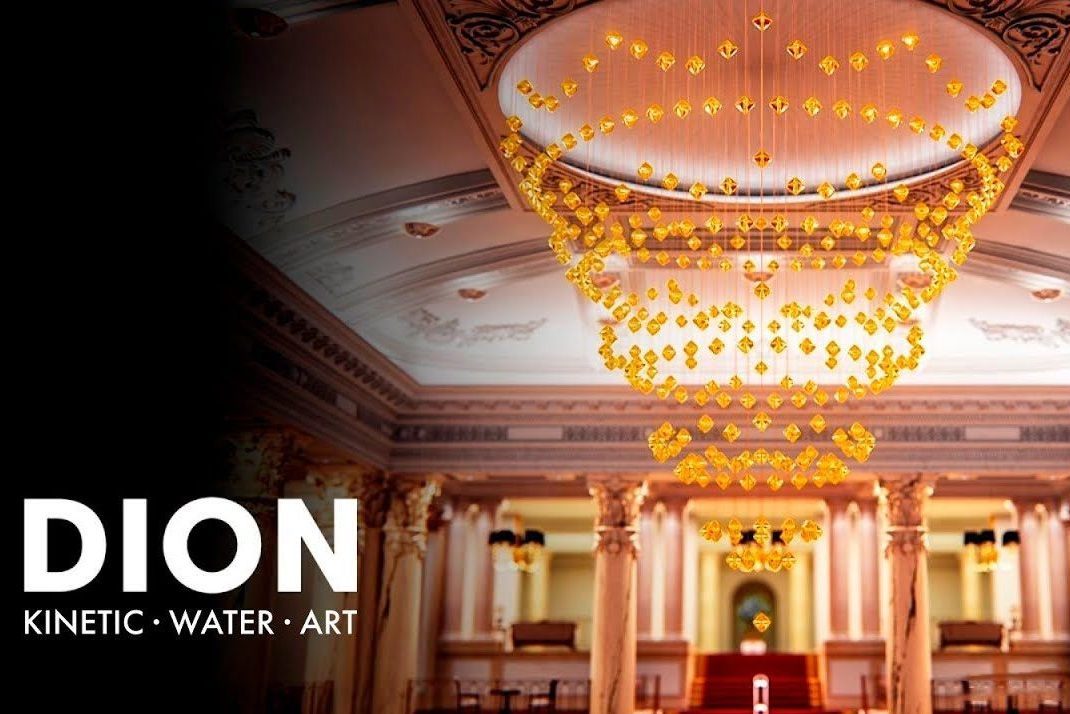
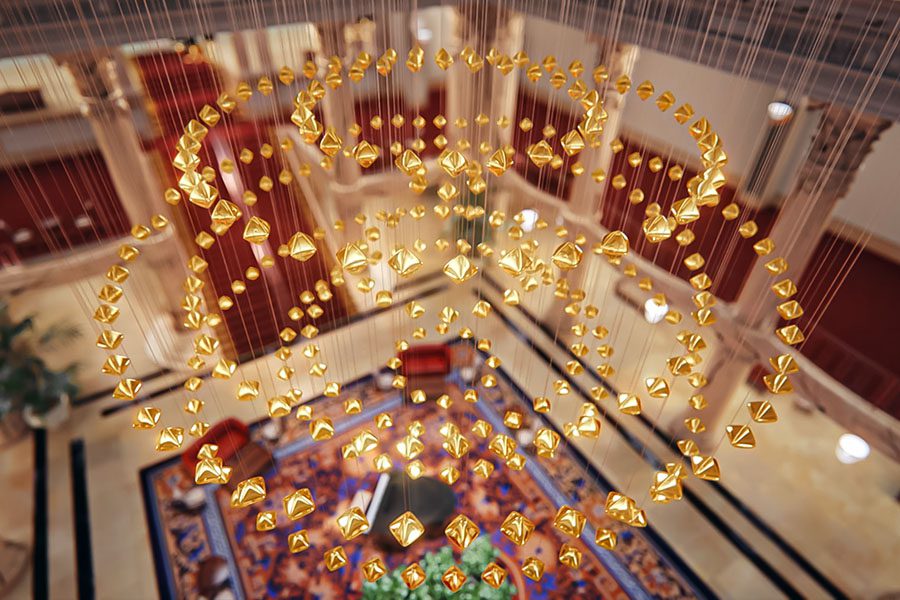
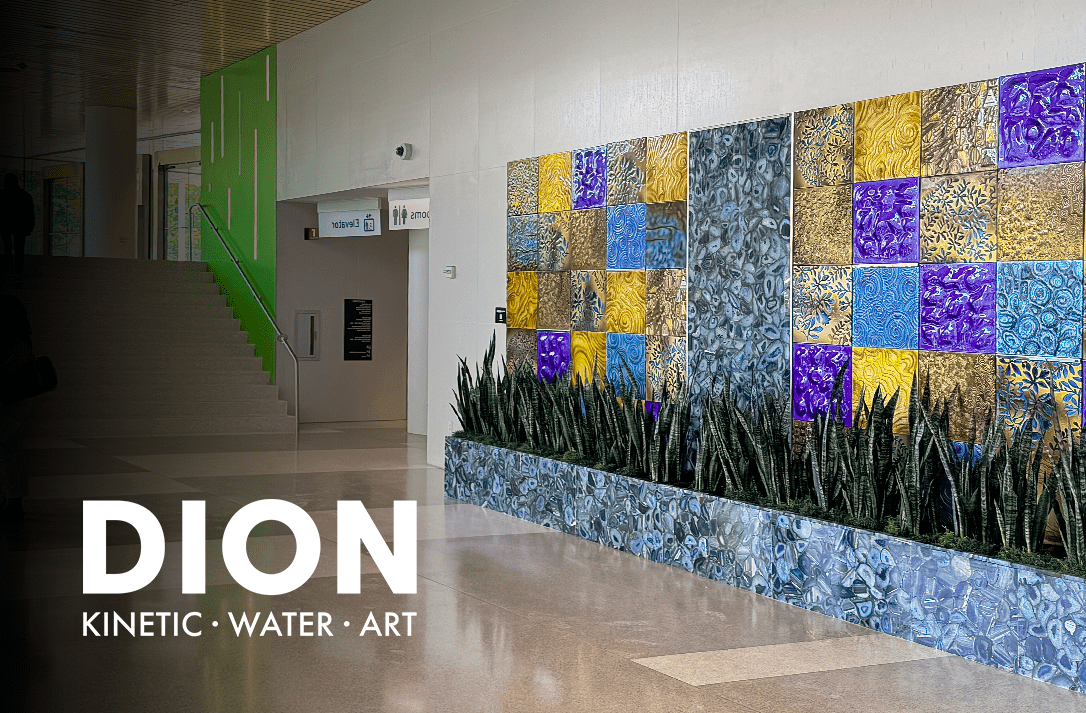
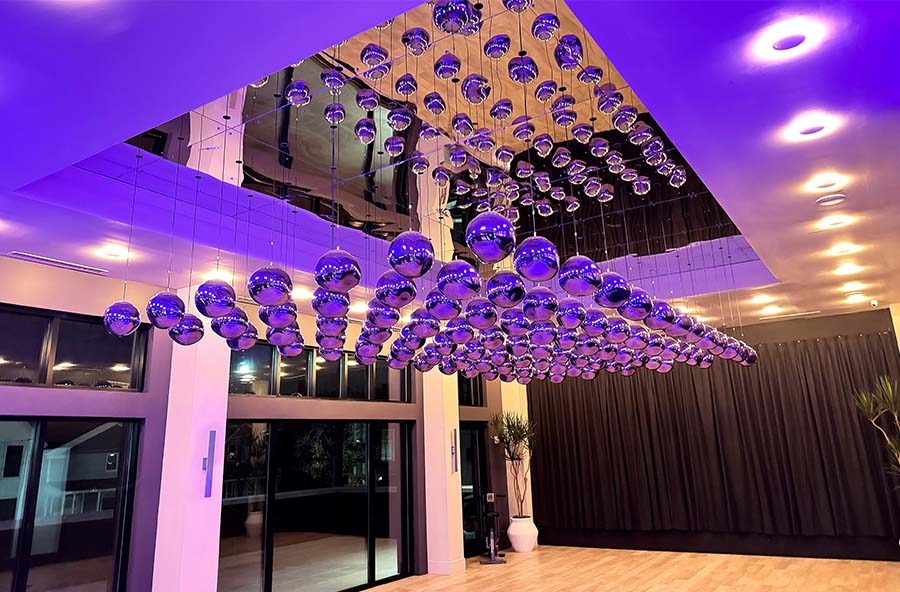
Kinetic installations can address this by occupying vertical space in a way that creates both proportion and focus. In a tall atrium, a suspended work can draw the eye upward while reducing the sense of abstraction that often comes with excessive height. It can make the volume feel intentionally composed rather than simply oversized. In broader lobby environments, it can establish a stronger center of gravity around which reception, seating, circulation, and waiting zones are more clearly understood.
This role is especially valuable in hospitality because vertical space is rarely only about orientation. It is about mood. Guests do not just need to know where check-in is. They need to feel whether the environment is serene, dramatic, intimate, luminous, or monumental. A kinetic installation can help shape that reading by altering how scale is perceived. It can compress a room that feels too diffuse, extend one that feels shallow, or add visual cadence to a volume that would otherwise remain passive.
Its effectiveness depends on precision. If the work competes with reception, interrupts sightlines, or overwhelms the acoustic and visual calm of the room, it weakens the space. If it is too small, it disappears. If it is too expressive for the property’s tone, it shifts the environment from luxury to spectacle. In hospitality, this boundary matters more than in most sectors.



Resort terraces, landscapes, and open-air transitions
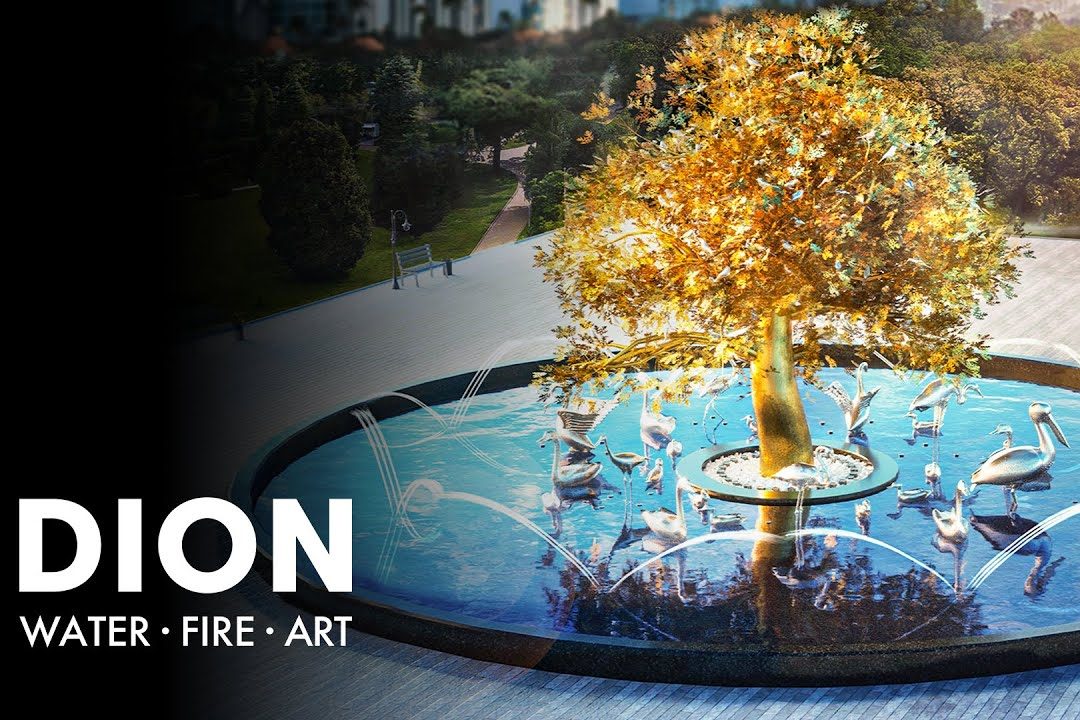
The hospitality value of kinetic installations is not limited to interiors. In resorts and landscape-led luxury developments, outdoor public space often carries as much experiential weight as the lobby itself. Pool courts, oceanfront terraces, wellness gardens, restaurant approaches, shaded pavilions, and circulation routes between suites all contribute to the identity of the property. These are precisely the environments where movement can become most atmospheric.
In outdoor settings, kinetic works interact with wind, sunlight, shadow, humidity, vegetation, and reflective surfaces such as water or glass. This can make them feel deeply embedded in the life of the site rather than placed onto it as isolated objects. In coastal, desert, or tropical hospitality projects especially, that responsiveness can intensify the sensory character of the environment.
A kinetic piece placed in a resort arrival court or garden threshold does not need to function only as an icon. It can also structure progression through the site. It may mark the transition from vehicular arrival to pedestrian calm, from lobby terrace to pool landscape, or from social space to wellness zone. In these cases, the installation helps mediate between the more public and more private layers of the hospitality environment.
This is especially important in large resorts where the guest journey depends on gradual atmospheric transitions rather than single focal moments. A kinetic installation can help hold those transitions together, creating continuity between one part of the property and the next. It carries identity beyond the interior and into the open-air sequence of the site.
Repeat experience and the luxury of change over time
One of the strongest reasons kinetic installations perform well in hospitality is that they reward repeat experience. Luxury properties are photographed constantly, but they are also lived over time. Guests pass through the same lobby several times a day. Residents in branded developments encounter the same shared spaces daily. Visitors return to bars, terraces, and restaurant approaches under different lighting and in different emotional states.
Static visual impact matters, but temporal variation matters more than many projects acknowledge. A kinetic installation changes the atmosphere of a space subtly across the day. It may read one way in morning light, another in evening illumination, and another from a lounge seat than from an entry axis. This makes the space more durable in perception. It does not exhaust itself after the first impressive moment.
That quality is particularly relevant in hospitality because luxury is tied to sustained freshness. The best environments do not rely on a single dramatic gesture. They remain compelling across multiple encounters. Kinetic installations support this because movement allows the same room, terrace, or court to feel renewed without being visually reconfigured.
This is one of the clearest distinctions between hospitality and more utilitarian environments. In a hotel or resort, the guest should not feel that the space has been fully consumed in the first five seconds. A certain degree of unfolding is part of the value of the experience.

Drama, restraint, and the calibration of luxury
One of the most important professional questions in hospitality is not whether a kinetic installation should be impressive, but what kind of impression it should create. Luxury environments often benefit from strong focal points, but they do not always benefit from spectacle. The relationship between drama and restraint is particularly sensitive in hotels and luxury developments because mood is part of the product.
Some properties depend on theatrical arrival, visual glamour, and strong social energy. Others depend on calm, exclusivity, and the sense that every element has been precisely controlled. In the first case, a more expressive kinetic work may be entirely appropriate. In the second, the same level of movement might feel intrusive or tonally wrong.
This is why kinetic installations in luxury hospitality must be calibrated not just architecturally, but emotionally. Movement speed, sound presence, material reflectivity, scale, visibility, and light response all contribute to whether the installation feels elegant or excessive. Even the difference between continuous motion and slower episodic motion can alter the tone of a room.
The strongest hospitality projects understand that luxury is often defined by what is withheld as much as by what is shown. A kinetic installation can heighten this effect beautifully when it is disciplined enough to support the atmosphere instead of dominating it.
Why early integration matters in hospitality projects
The most successful kinetic installations in hotels and luxury developments are rarely inserted at the end as visual embellishments. They are integrated during the design process, when they can still influence spatial hierarchy, arrival sequence, lighting logic, servicing strategy, and the overall atmosphere of the property.
This is especially important in hospitality because operational clarity and experiential quality must coexist. A lobby installation must work in relation to reception, concierge, seating zones, acoustics, lighting, and guest circulation. An outdoor work must account for wind exposure, water management, structural anchoring, maintenance access, and nighttime visibility. In restaurants, spas, and amenity areas, it must support mood without disrupting intimacy.
Late-stage art seldom performs as well in these conditions. By the time the interiors are fixed and the public spaces are already composed, the installation often becomes decorative rather than spatially meaningful. It may still create a focal point, but it is less likely to strengthen the deeper logic of the property.
This is exactly why hospitality teams benefit from involving studios that work across art, architecture, and engineering from the early phases. At DION ART STUDIO, this overlap is where the installation becomes most valuable. The central question is not only what the artwork should look like. It is how movement, scale, integration, and technical coordination can help shape the identity and atmosphere of the hospitality environment before those conditions are locked in.
When kinetic installations underperform in luxury settings
Kinetic installations do not automatically elevate a hotel or luxury development. In some projects, they underperform because the property treats them as premium symbols without giving enough attention to context. A dramatic moving object in a weak lobby does not create atmosphere by itself. A visually impressive piece placed without regard to circulation, acoustics, seating, or guest flow can make the environment feel staged rather than refined.
Another common issue is tonal mismatch. Luxury hospitality depends on control of mood. Some projects need restraint, softness, and slow movement. Others benefit from stronger visual drama. If the installation’s behavior, scale, or material language does not correspond to the property’s brand and guest profile, it can feel more like a statement piece than an integrated part of the experience.
There is also the question of operational burden. Highly technical or interactive installations may look compelling in concept, but hospitality environments demand reliability, easy servicing, and consistent performance. In luxury settings, technical failure is not neutral. It disrupts the sense of control the property is meant to project. This is why the right solution is not always the most complex one. A restrained kinetic work with strong placement and atmospheric clarity may outperform a more elaborate system with heavier maintenance demands.
Kinetic installations as hospitality infrastructure
The most mature luxury developments understand that atmosphere, identity, and spatial choreography are inseparable. Kinetic installations can contribute to all three simultaneously. They give the property a memorable focal point, shape how the guest moves and feels through the environment, and reinforce the emotional quality that distinguishes hospitality from other sectors.
For that reason, they are better understood not as luxury extras, but as a form of hospitality infrastructure. They do not replace architecture, landscape, lighting, or interior design. They strengthen those systems by giving the property a more concentrated experiential core. In premium environments, that concentrated core is often what transforms refinement into distinction.
This matters because the US luxury market is increasingly competitive across hotels, resorts, branded residences, and high-end hospitality developments. Projects cannot rely on finish level alone. They must create places that are memorable, photographable, atmospherically precise, and experientially coherent. Kinetic installations can help achieve exactly that when they are planned with architectural discipline and strategic clarity.
Kinetic installations have become increasingly relevant in hotels and luxury developments in the United States because they do more than add visual interest. They can sharpen arrival, reinforce brand identity, structure lobby and atrium experience, animate outdoor hospitality spaces, and strengthen the emotional character of the property over time.
For developers, hotel brands, architects, and operators, their value lies in integration. The most effective installations are not standalone objects chosen to signal exclusivity. They are part of the architectural, sensory, and operational logic of the development itself. They help a hotel or luxury property feel more legible, more memorable, and more distinct from the moment of arrival onward.
In premium hospitality, that distinction matters. Guests do not remember properties only through service or finish. They remember them through atmosphere, sequence, and identity. A kinetic installation, when developed with spatial intelligence and technical precision, can become one of the defining elements of that memory.
The greatest value usually appears when the installation is considered before the emotional and spatial logic of the property has been finalized. In hospitality, timing is not secondary. It determines whether the work becomes part of the guest experience itself or remains only an elegant object within it.
Contact Us
Integrating a kinetic installation into a hotel or luxury development requires more than selecting a visually striking feature. It involves understanding arrival choreography, guest perception, operational flow, public and private gradients, spatial hierarchy, technical coordination, and the tone the property is meant to project.
At DION ART STUDIO, we work with developers, architects, and hospitality teams to create kinetic and public art installations that function as part of the built environment rather than as isolated visual additions. From concept development and spatial integration to engineering coordination, fabrication, and installation planning, our approach is shaped by the relationship between movement, atmosphere, and architecture.
If you are planning a hotel, resort, branded residence, or luxury development in the US and exploring how kinetic installations can strengthen arrival, guest experience, and the identity of the property, the most effective moment to discuss the work is during the design phase, before the experiential logic of the project is already fixed.
Because they introduce movement, atmosphere, and memorability into spaces where first impression and emotional experience are central to the value of the property.
Common locations include arrival courts, porte-cochère zones, lobbies, atria, resort terraces, central plazas, restaurant approaches, and landscape-driven hospitality spaces.
Yes, especially when they are designed to respond to light, wind, water, and landscape conditions, which can make outdoor public spaces feel more atmospheric and integrated.
Yes, especially when they are used to create a stronger shared identity for the building or campus and improve the quality of common space used by tenants and visitors.
Ideally during early design stages, when placement, circulation, structure, lighting, servicing, and the overall guest experience can all be coordinated with the architecture.
Written by

Сo-founder & Creative director of DION ART
Master of Arts in Art Education, Public Art (School of the Art Institute of Chicago, USA)
Share this post